
Much Food for Thought

Regardless of what you believe about the Last Supper, there are many questions that need to be considered. The information provided below is not meant to sow seeds of doubt about the words and actions of the Last Supper. Rather, it’s purpose is to provide a broader interpretation and understanding of the event.
Jesus Washes His Disciples’ Feet according to His disciple John
This is an important prelude to the celebration of the Passover meal that is also known as the Last Supper.

“It was just before the Passover Festival. Jesus knew that the hour had come for him to leave this world and go to the Father. Having loved his own who were in the world, he loved them to the end. The evening meal was in progress, and the devil had already prompted Judas, the son of Simon Iscariot, to betray Jesus. Jesus knew that the Father had put all things under his power, and that he had come from God and was returning to God; so he got up from the meal, took off his outer clothing, and wrapped a towel around his waist. After that, he poured water into a basin and began to wash his disciples’ feet, drying them with the towel that was wrapped around him.
He came to Simon Peter, who said to him, “Lord, are you going to wash my feet?”
Jesus replied, “You do not realize now what I am doing, but later you will understand.”
“No,” said Peter, “you shall never wash my feet.”
Jesus answered, “Unless I wash you, you have no part with me.”
“Then, Lord,” Simon Peter replied, “not just my feet but my hands and my head as well!”
Jesus answered, “Those who have had a bath need only to wash their feet; their whole body is clean. And you are clean, though not every one of you.” For he knew who was going to betray him, and that was why he said not everyone was clean.
When he had finished washing their feet, he put on his clothes and returned to his place. “Do you understand what I have done for you?” he asked them. “You call me ‘Teacher’ and ‘Lord,’ and rightly so, for that is what I am. Now that I, your Lord and Teacher, have washed your feet, you also should wash one another’s feet. I have set you an example that you should do as I have done for you. Very truly I tell you, no servant is greater than his master, nor is a messenger greater than the one who sent him. Now that you know these things, you will be blessed if you do them. Maundy (foot washing) – Wikipedia
The “Last Supper”
There is much controversy about the events of the Last Supper as well the discrepancies about the actual words and actions that Jesus used during the meal.

Much of the confusion about the Last Supper event is due to the oral traditions, explanations, and beliefs of the early Church communities, their elders and overseers.
Here are the scripture accounts listed according to the dates of their writing
1 Corinthians 11:23 ASV – For I received of the Lord that which – Bible Gateway 57 CE
Mark 14:22-24 ASV – And as they were eating, he took bread, – Bible Gateway 60s CE
2 Peter 2:13 “They will be paid back with harm for the harm they have done. Their idea of pleasure is to carouse in broad daylight.They are blots and blemishes, reveling in their pleasures while they feast with you.”
Matthew 26:26-28 NIV – While they were eating, Jesus took – Bible Gateway 70s CE
Luke 22:19-20 ASV – And he took bread, and when he had – Bible Gateway
70-80 CE

Acts 2 “They devoted themselves to the apostles’ teaching and to fellowship, to the breaking of bread and to prayer. 43 Everyone was filled with awe at the many wonders and signs performed by the apostles. 44 All the believers were together and had everything in common. 45 They sold property and possessions to give to anyone who had need. 46 Every day they continued to meet together in the temple courts. They broke bread in their homes and ate together with glad and sincere hearts, 47 praising God and enjoying the favor of all the people. And the Lord added to their number daily those who were being saved.
Jude 12: “These people are blemishes at your love feasts, eating with you without the slightest qualm—shepherds who feed only themselves. They are clouds without rain, blown along by the wind; autumn trees, without fruit and uprooted—twice dead.”
John 13 90 CE
includes the account of the washing the feet of the Apostles by Jesus before the meal and the only specific reference to what happened during the meal are these words spoken by Jesus after John asked who would betray Jesus: “It is the one to whom I will give this piece of bread when I have dipped it in the dish.”
Prior to the latest scripture scholarship from the 18th century to the present, authoritative words and interpretations of the “Church Fathers” and other noted Church leaders in the first 5 centuries were accepted and approved by the “Magisterium” of the Roman Catholic Church.
Between those discrepancies and the confusion about the nature of Jesus, human, Divine or both, It’s my opinion that the person of Jesus became more important than most of the teachings and message of Jesus.
Add to all of that, the disputes about the meaning and significance of the bread and wine and the words of Jesus, and you have a Christianity broken into many parts. Here’s what I mean.
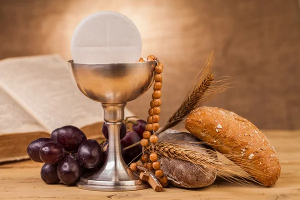
Basically, Catholics believe in transubstantiation – that the bread and wine are physically changed into the body and blood of Christ.
However, a Pew Research Center survey finds that most self-described Catholics don’t believe this core teaching. In fact, nearly seven-in-ten Catholics (69%) say they personally believe that during Catholic Mass, the bread and wine used in Communion “are symbols of the body and blood of Jesus Christ.” Just one-third of U.S. Catholics (31%) say they believe that “during Catholic Mass, the bread and wine actually become the body and blood of Jesus.”
Just one-third of U.S. Catholics agree with their church that Eucharist is body, blood of Christ
On the other hand, in most Protestant churches, communion is seen as a memorial of Christ’s death. The bread and wine do not change at all because they are symbols.
Two significant groups at least loosely associated with Protestantism that don’t observe communion are The Salvation Army and the Quakers aka, Friends. The rationale for the Salvation Army’s position is more fully explained here: Why does the Salvation Army not administer the sacraments of baptism and the Lord’s Supper? But the short version is that they don’t observe the Lord’s Supper because it has been a source of division in the church, and it is not required for salvation.
The rationale for Quakers focuses more on all of life being “sacramental” and don’t regard some activities as more sacred than others, nor do they believe that any particular ritual is needed to communicate with God, so they do not believe in the sacraments as practiced in mainstream Christian churches.
As for Messianic Jews, their practice varies on the actual denomination to which they belong. Some celebrate communion as the annual celebration of Passover, while others observe it regularly as other Protestants do.
As for the words of Jesus’s command to eat and drink the bread and wine, which becomes his body and blood, many scholars have speculated that according to J. Godwin’s, Mystery Religions of the Ancient World, 1981, it seems that a Persian Mithraic text, from around the 5th century BCE contains words that are amazingly reminiscent of Jesus’s words. The text states that ‘he who will not eat of my body and drink of my blood, so that he will be made one with me and I with him, the same shall not know salvation.’
The following information provides more insight about more similarities between Jewish, Christian, and Zoroastrianism.
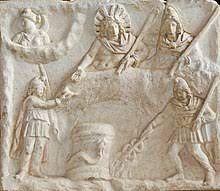
In addition, many doctrines of the Christian faith have parallels in Zoroastrianism, e.g., the virgin birth, the son of God, and resurrection. Some scholars say that Zarathustra (a.k.a. Zoroaster) lived around 600–500 BC. If that is the case, David, Isaiah, and Jeremiah (all of whom mention the Messiah, the resurrection and the final judgment in their writings), lived and wrote before Zarathustra. Some scholars say that Zoroaster lived sometime between 1500 and 1200 BC. If that is the case, the case for Christianity borrowing from Zoroastrianism would be stronger, but the fact is we don’t know when Zarathustra lived (hence the disagreement among scholars), and so this argument is speculative at best. The Greek historian Herodotus (5th century BC) doesn’t mention Zoroaster in his treatise on the Medo-Persian religions, though Plato, who was born roughly around the time Herodotus died, does mention him in his Alcibiades (see Wikipedia’s entry on Zoroaster; Zoroaster – Wikipedia The Origins Of Mithraism
Another event describing the “real presence” of Jesus comes after the resurrection. It appears in Luke’s gospel.
Luke 24:13-35 NIV – On the Road to Emmaus – Now that same – Bible Gateway.
On the Road to Emmaus
“Now that same day two of them were going to a village called Emmaus, about seven miles from Jerusalem. They were talking with each other about everything that had happened. As they talked and discussed these things with each other, Jesus himself came up and walked along with them; but they were kept from recognizing him.
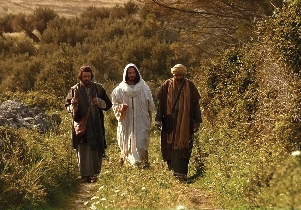
He asked them, “What are you discussing together as you walk along?”
They stood still, their faces downcast. One of them, named Cleopas, asked him, “Are you the only one visiting Jerusalem who does not know the things that have happened there in these days?”
“What things?” he asked.“About Jesus of Nazareth,” they replied. “He was a prophet, powerful in word and deed before God and all the people. The chief priests and our rulers handed him over to be sentenced to death, and they crucified him; but we had hoped that he was the one who was going to redeem Israel. And what is more, it is the third day since all this took place. In addition, some of our women amazed us. They went to the tomb early this morning but didn’t find his body. They came and told us that they had seen a vision of angels, who said he was alive. Then some of our companions went to the tomb and found it just as the women had said, but they did not see Jesus.”
He said to them, “How foolish you are, and how slow to believe all that the prophets have spoken! Did not the Messiah have to suffer these things and then enter his glory?” And beginning with Moses and all the Prophets, he explained to them what was said in all the Scriptures concerning himself.
As they approached the village to which they were going, Jesus continued on as if he were going farther. But they urged him strongly, “Stay with us, for it is nearly evening; the day is almost over.” So he went in to stay with them.
When he was at the table with them, he took bread, gave thanks, broke it and began to give it to them. Then their eyes were opened and they recognized him, and he disappeared from their sight. They asked each other, “Were not our hearts burning within us while he talked with us on the road and opened the Scriptures to us?”
Coincidentally, a similar story appears in Greek literature. The beginning of Plato’s Symposium mirrors the end of the Gospel of Luke with many parallel elements including identical language, plot points, and themes.


 Faith Seeking Understanding
Pingback: Jesus the suffering man who called to God – Some View on the World