

“God glows and burns with all the divine wealth and all the divine bliss in the spark of the soul” and is never extinguished there. Hidden in this spark is something like the original outbreak of all goodness, something like a brilliant light that glows incessantly and something like a burning fire which burns incessantly. This fire is nothing other than the Holy Spirit.” Meister Eckhart
The presence of the Sacred is heard on the lips of humans all around the world: “Oh my God”, “Dio mio” “oh mein Gott” “Oh Dios Mios”.
Exclamations like, “For God’s sake!”, “God bless you!”, My God, you scared me!, Oh my God, are you all right?, “Thank God!” are heard every day in many different circumstances.
God’s name even appears in movie titles on the Margees of theaters and on the cover of books and in the titles of songs: “Oh God”, “Mad God”, “God’s Own Country”, “Children of a lesser God”, “Let Go, Let God”, :God Bless America,, The Beach Boy’s song “That’s Why God Made the Radio”, “God, If I Saw Her Now” by Anthony Phillips

“God has in fact been portrayed in movies ever since the days of silent cinema, in biblical epics, experimental films, everyday dramas, and comedies. A cantankerous animated God instructs King Arthur and his knights with their mission in the 1975 comedy Monty Python and the Holy Grail.[10] Robert Mitchum portrayed a cigar-smoking, American, God in Frédéric Fonteyne’s 1992 comedy Les Sept péchés capitaux.[2] A suicidal supreme being identified as “God Killing Himself” expires in an act of self-immolation in E. Elias Merhige‘s 1991 avant-garde feature Begotten.[11] In Carlos Diegues‘ 2003 movie Deus é Brasileiro, God is a down-to-Earth character, exhausted from his labours, who is taking a rest in the north east of Brazil.[2]
God as a character is often mentioned or intervenes in the plot of the CW show Supernatural, and eventually served as the ultimate villain of the series. He seems as a loving, smart, serious, strategic, all-seeing, father, who observes events play out, but ignores them unless he absolutely needs to fix something. God has also been portrayed by actor Dennis Haysbert in the DC comics based show Lucifer (TV series) starting in 2020 and 2021. One of the more recent movies, The Shack (2017) was an American Christian drama in which God was portrayed by an African-American woman, Octavia Spencer, who was called Papa.
“Perhaps the human tendency to use these kinds of characters and images of God is why the first Commandment of the Decalogue forbids idols and images. There is always the danger of confining God to a persona, character, picture, statue, and an idea.” Peter Malone in Traces of God: Understanding Gods Presence in the World Today
Malone suggests that we look around NOT up for God. He claims that, we can experience God’s presence in music, nature, our lives including relationships and events and much more.
Perhaps the most influential depiction of God is the work of art known as the Creation of Adam, a fresco painting by Italian artist Michelangelo, which forms part of the Sistine Chapel’s ceiling, painted c. 1508–1512.

In it, God is depicted as an elderly white-bearded man, wrapped in a swirling cloak. God’s right arm is outstretched to impart the spark of life from his own finger into that of Adam, whose left arm is extended in a pose mirroring God’s, a reminder that man is created in the image and likeness of God (Gen. 1:26).
The image of God as a person is one of the most common descriptions of God, the Creator of our world and of the universe. This is no surprise for members of Judaism and most denominations of Christianity since humans are made in God’s image and likeness. Could we infer from this that God is a person like us? We Catholics and many Christians must believe that since we refer to God as, “he” and “father” which also implies that God is a male.
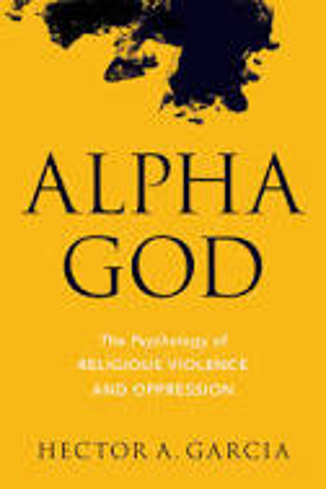
In Hector Garcia’s book Alpha God (2015), he claims that each of the three major monotheistic traditions focuses on a male figure, one who strongly resembles an alpha male at the head of a social group, according to David P Barash, writing in Aeon Magazine. According to Barash, Garcia “suggests that the monotheistic God could be modeled on a harem-keeping alpha male. “
However, “Sophisticated theologians typically emphasize that their deity lacks a physical body, somehow transcending physicality. More rarely, God might be conceived as non-gendered. Nonetheless, there is little doubt that the great majority of believers imagine a personal god who can be spoken to, who answers prayers, who has strong opinions and often discernible emotions, too: sad, angry, pleased, displeased, vengeful, jealous, forgiving, loving, and so forth.” David Barash. How monotheists modelled god on a harem-keeping alpha male | Aeon Essays
Many claim that Jesus refers to God as Abba(father) despite the many Jewish names found in the Old Testament: Yahweh (YHVH) – (Jehovah)- Elohim- Adonai-El Shaddai, Jewish Concepts: The Name of God
However, “No Jew ever called God abba, yet the evangelists record that Jesus always called God abba, ‘my Father’ (except for the cry from the cross, Mark 15.34).”Joachim Jeremias The Prayers of Jesus (trans. C. Burchard and J. Reumann; London: SCM, 1967

“Some have claimed that calling God “Abba” would have been considered offensive, and perhaps blasphemous, to Jesus’ Jewish contemporaries.” Jeremias, New Testament Theology, 67
“The term “abba” is only found in the New Testament three times—in Mark 14:36, Romans 8:15, and Galatians 4:6—and is used only by Jesus and Paul. In each instance, abba is transliterated into Greek and accompanied by the Greek translation of “father,” ho patēr ” John D. Barry, et al. Lexham Bible Dictionary, “Abba.” (Bellingham, WA), 2016.
Scholars are conflicted about Jesus’ use of Abba. For more information about this go to: Did Jesus Call God “Abba”? | JerusalemPerspective.com Online
Does God have a Sexual Identity?
Perhaps in some minds! “The first words of the Old Testament are B’reshit bara Elohim—”In the beginning God created.”[1] The verb bara (created) agrees with a masculine singular subject.[citation needed]
However, Elohim is used to refer to both genders and is plural; it has been used to refer to both Goddess (in 1 Kings 11:33), and God (1 Kings 11:31;[2]). The masculine gender in Hebrew can be used for objects with no inherent gender, as well as objects with masculine natural gender, and so it is widely used, attributing the masculine gender to most things.[citation needed]
However, the noun used for the Spirit of God in Genesis—”Ruach”—is distinctly feminine, as is the verb used to describe the Spirit’s activity during creation—”rachaph”—translated as “fluttereth”. This verb is used only one other place in the Bible (Deuteronomy 32:11) where it describes the action of a mother eagle towards her nest. The consistent use of feminine nouns and verbs to refer to the Spirit of God in the Torah, as well as the rest of the Jewish Scriptures, indicates that at least this aspect of Elohim was consistently perceived as feminine.[3] Genesis 1:26-27 says that humans were made male and female in the image of elohim.[4][5]
Two of the most common phrases in the Tanakh are vayomer Elohim and vayomer YHWH—”and God said”. Again, the verb vayomer (he said) is masculine; it is never vatomer, the feminine of the same verb form. The personal name of God, YHWH, is presented in Exodus 3 as if the Y (Hebrew yod) is the masculine subjective prefix to the verb to be.[citation needed]
In Psalm 89:26 God is referred to as Father. “He shall cry unto me, Thou art my Father, My God, and the rock of my salvation.”[6]
In the book of Isaiah, the prophet himself brings up feminine imagery for God, comparing God to a woman in labor in multiple verses throughout the book.[7] The book also refers to God as a nursing mother.[8]” Gender of God in Christianity – Wikipedia
It’s obvious to me that Jewish and Christian patriarchs were the dominant influence when it came to describing or referring to God as masculine. The father of a family was seen as the ultimate authority in most cultures and religions even in some societies today. It is only natural, then, that in the ancient world, any transcendent power would be considered masculine.

However, such references to God as “father” or he and him have been and still are used in the prayers and liturgies of the Catholic Church and in most Protestant Churches as well. This despite the admittance that “God transcends the human distinction between sexes.”
“The Catechism of the Catholic Church (CCC) #239 states, in reference to the Father: “God transcends the human distinction between the sexes. He is neither man nor woman: He is God.”[14][15] The CCC discusses the traditional imagery and language of God as Father.[15] It notes, however, that God is not limited to this role alone—maternal imagery are also used in the Bible.[15] It also notes that human fatherhood only imperfectly reflects God’s archetypal fatherhood.[15] God is referred to as masculine in Catholic teaching and practice.[16]
Though Church teaching, in line with its Doctors, holds that God has no literal sex because God possesses no body (a prerequisite of sex),[17][18] classical and scriptural understanding states that God should be referred to (in most contexts) as masculine by analogy. It justifies this by pointing to God’s relationship with the world as begetter of the world and revelation.[19]” Gender of God in Christianity – Wikipedia
In the 21st century, “God’s relationship with the world as “begetter of the world and revelation” is a patriarchal and sexist justification for using “Father” or “he” and him” in any ecclesiastical language and worship.
Is it Time for Another Divine Persona?

In his book, Reimaging God: The Faith Journey of a Modern Heretic, Lloyd Geering writes that ” God is an idea in the human mind, a concept first created by our human ancestors in the distant cultural past and then transmitted in culture from generation to generation.”
Geering then says that “we have reached a crucial point in our cultural evolution because the idea of God has now become problematic.” That is why, by the middle of the twentieth century, theologians began to speak of the ‘death of God’.”
Richard Dawkins in his book, God is a Delusion, and Christopher Hitchens in, God is Not Great have claimed that the notion of God was and is the greatest elusive danger that faces humanity. It’s hard to disagree with them as there’s little doubt that most wars and terrorist violence have been initiated in the name of God.
Geering recommends several additional books and authors which influenced his theological update. One book was the three volume Systematic Theology of Paul Tillich. Such authors a Rudolf Bultmann, Dietrich Bonhoeffer, and Pierre Teilhard de Chardin whose book, The Phenomenon of Man which combined the new knowledge of the cosmos provided by physics, chemistry, biology, and theology also provides new insights about redefining God.
Geering found that “Tillich’s enigmatic phrase ‘being itself’: God was not so much the maker of the world or the cause of the evolutionary process; rather, the mysterious process of an evolving universe was God.”
Some of the chapters in Geering’s book that may provide new insights about a new persona for God are:
Chapter 3. Friedrich Schleiremacher: God is Experienced
Chapter 4. Ludwig Feuerbach: God is Humanity Projected
Chapter 5. Carl Jung: God in the Unconscious
Chapter 6. Pierre Teilhard de Chardin: God is Evolving
Chapter 7 John Robinson: Honest to God
In his book, God After Einstein: What’s Really Going on in the Universe, John F. Haught writes, “I seek an understanding of God commensurate with the new understanding of nature and time that recent cosmology-the scientific study of the universe as a whole- has introduced into the world of thought…. How, for example, can I reconcile my belief in God with evolutionary biology, especially since the latter has led so many other science-lovers to atheism.”
There is no doubt in the mind of most reasonable Christians, and Catholics in particular, that the God of our ancestors can no longer relate to our 21st century minds and beliefs. We must realize that finite beings, such as we humans, cannot possibly comprehend the infinite mystery we call God. The best we can do is seek to redefine the meaning of God and in the process come to admit, that no matter what we think or believe, God is a mystery that penetrates the entire universe.
There is more to come!


 Faith Seeking Understanding