Emphasizing the dignity of the human person, the common good, and the preferential option for the poor, while also advocating for the protection of life, family, and the environment.
According to Pope John Paul II, the foundation of social justice “rests on the threefold cornerstones of human dignity, solidarity and subsidiarity”.[2] According to Pope Benedict XVI, its purpose “is simply to help purify reason and to contribute, here and now, to the acknowledgment and attainment of what is just … [The church] has to play her part through rational argument and she has to reawaken the spiritual energy without which justice … cannot prevail and prosper.”[3]Pope Francis, according to Cardinal Walter Kasper, has made mercy “the key word of his pontificate … (while) Scholastic theology has neglected this topic and turned it into a mere subordinate theme of justice.”[4]: 31–32
Catholic social teaching is critical of modern social and political ideologies of the left and of the right, such as liberalism, atheistic forms of socialism and communism,[5]anarchism, atheism,[6]fascism, capitalism,[7] and Nazism,[8] which have been condemned by several popes since the late nineteenth century. It has tried to strike a balance between respect for human liberty (including the right to private property and subsidiarity) and concern for society, including the weakest and poorest.[9] It is explicitly anti-capitalist, with John Paul II stressing the incompatibility of Catholic doctrine with capitalism:
Catholic social doctrine is not a surrogate for capitalism. In fact, although decisively condemning “socialism”, the church, since Leo XIII’s Rerum Novarum, has always distanced itself from capitalistic ideology, holding it responsible for grave social injustices. In Quadragesimo Anno Pius XI, for his part, used clear and strong words to stigmatize the international imperialism of money.[10]
From Wikipedia, the free encyclopedia
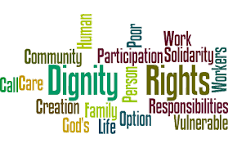
Key Themes and Principles:
Dignity of the Human Person:Every person is created in the image and likeness of God and possesses inherent dignity, regardless of race, ethnicity, gender, social status, or any other characteristic.
Call to Family and Community:The family is the fundamental unit of society, and communities are essential for human flourishing. Catholic social teaching emphasizes the importance of strong families and communities that promote the common good.
Rights and Responsibilities:Every person has fundamental rights, including the right to life, freedom, and the necessities for a decent life. Corresponding to these rights are responsibilities to one another, to our families, and to society.
Option for the Poor and Vulnerable:A basic moral test is how our most vulnerable members are faring. Catholic social teaching calls for a preferential option for the poor and vulnerable, ensuring their needs are met and their dignity is protected.
Dignity of Work and the Rights of Workers:Work is a fundamental human activity and a way to participate in God’s creation. The economy must serve people, not the other way around, and workers have the right to decent and fair wages, safe working conditions, and the ability to organize and join unions.
Solidarity:We are all interconnected and responsible for one another. Solidarity calls us to work together to build a more just and peaceful world, recognizing that our common humanity binds us together.
Care for God’s Creation:We are stewards of God’s creation and have a responsibility to protect the environment and ensure its sustainability for future generations.
Social Justice Issues Addressed by Catholic Social Teaching:
Poverty and Inequality:Catholic social teaching calls for the eradication of poverty and the reduction of economic inequality, emphasizing the importance of social programs and policies that address the root causes of poverty.
Racial Justice:Catholic social teaching condemns all forms of racism and discrimination, calling for the promotion of racial equality and justice.
Healthcare:Access to quality healthcare is a fundamental human right, and Catholic social teaching calls for universal healthcare access and the protection of the vulnerable.
Education:Education is essential for human flourishing and the development of a just society. Catholic social teaching emphasizes the importance of access to quality education for all.
Environmental Issues:Catholic social teaching calls for the protection of the environment and the promotion of sustainable practices, recognizing the interconnectedness of all living things.
Immigration:Catholic social teaching calls for just and humane immigration policies, recognizing the dignity of all migrants and the right to seek refuge.
Abortion:Catholic social teaching opposes abortion, viewing it as a violation of the right to life.
Marriage and Family:Catholic social teaching affirms the importance of marriage as a sacred institution and the family as the fundamental unit of society.
Social Justice – List of Social Encyclicals
Pope Leo XIII
Rerum Novarum: On the Condition of Workers
Issued on the fifteenth of May 1891. Literally “Of New Things,” on capital and labor and the condition of the working class. This was the most significant of all the encyclicals before or since.
Rerum Novarum broke down the barriers that separated the church from the worker. Never before had the church spoken on social matters in such an official and comprehensive fashion**.
Quadragesimo Anno: On the Reconstruction of the Social Order
Issued May 15, 1931. Literally “In forty Years,” commemorating the fortieth anniversary of Rerum Novarum This encyclical repeated many of the themes of Rerum Novarum: the dignity of labor, the rights of workers to organize, etc.
Quadragesimo anno also emphasized the immorality of keeping economic control in the hands of a few. It recognized the principle of subsidiarity which held that higher levels of authority should act only when lower levels cannot deal with a problem. **
Issued May 15, 1961. Literally “Mother and Teacher,” on Christianity and Social progress. This encyclical gave an updated interpretation of the classic theme of private property and introduced the notion of private initiative as an extension of private property. While Rerum Novarum and Quadragesimo Anno left responsibility for social justice with the individual, Mater et Magistra placed some in the hands of the state. (this encyclical needs to be read in conjunction with Pacem in Terris, literally “Peace on Earth,” Pope John XXIII’s other great encyclical.) **
Populorum Progressio: On the Development of People
Issued March 26, 1967. Literally “On the Progress of Peoples.” A vigorous endorsement of Mater et Magistra, Populorum Progressio presented Catholicism as no longer tied to a social system based on natural law, but rather as a proponent of a pluralistic, decentralized approach to economic problems.
Issued on September 14, 1981. Literally “On Human Work.” Laborem Exercens focused on the themes that work is central to the social question and that work has potential not only to dehumanize but also to be the means whereby the human person cooperates in God’s ongoing creation.
Sollicitudo Rei Socialis: On the Twentieth Anniversary of Populorum Progressio
Issued on December 30, 1987. Literally “On Social Concerns,” commemorating the twentieth anniversary of Populorum Progressio. Solicitudo Rei Socialis presented an overview of modern social problems with some guidelines for action. It dealt with authentic human development and adopted a critical attitude toward both capitalism and communism. Sollicitudo Rei Socialis warned that economic development alone may not set people free but only enslave them more. **
Centesimus Annus: The Hundredth Anniversary of Rerum Novarum
Issued on May 1, 1991. Literally, “The Hundredth Year,” commemorating the one hundredth anniversary of Rerum Novarum. Centesimus Annus brought Rerum Novarum up to date and tied it to “the preferential option for the poor.” done in the context of the collapse of communism in Eastern Europe and the Soviet Union, Centesimus Annus still criticized both capitalism and communism.
Pope Benedict’s third encyclical, is a call to see the relationship between human and environmental ecologies and to link charity and truth in the pursuit of justice, the common good, and authentic human development. In doing so, the pope points out the responsibilities and limitations of government and the private market, challenges traditional ideologies of right and left, and calls all men and women to think and act anew.
EVANGELII GAUDIUM OF THE HOLY FATHER FRANCIS TO THE BISHOPS, CLERGY, CONSECRATED PERSONS AND THE LAY FAITHFUL ON THE PROCLAMATION OF THE GOSPEL IN TODAY’S WORLD



 Faith Seeking Understanding