Is the Church a “society of un-equals” ?

clergy (teachers, rulers, and sanctifiers)  laity (led, taught, and sanctified).

Clergy and Laity

In 1 Peter 5, the author explicitly warns the early Church leaders: “I exhort the presbyters among you, as a fellow presbyter and witness to the sufferings of Christ and one who has a share in the glory to be revealed. ”Tend the flock of God in your midst, [overseeing] not by constraint but willingly, as God would have it, not for shameful profit but eagerly. Do not lord it over those assigned to you, but be examples to the flock. And when the chief Shepherd is revealed, you will receive the unfading crown of glory. Likewise, you younger members, be subject to the presbyters. And all of you, clothe yourselves with humility in your dealings with one another, for:

“God opposes the proud.” but bestows favor on the humble.”

Once Christianity became the religion of Rome in the 4rh century, the presbyter (elder or pastor)  and episkopos (overseer or bishop) became the “lording agents”  of the Roman Empire. Remember, the Roman emperor, Constantine, played an influential role in the proclamation of the Edict of Milan in 313, which declared tolerance for Christianity in the Roman Empire. He convoked the First Council of Nicaea in 325, which produced the statement of Christian belief known as the Nicene Creed. The papal claim to temporal power in the High Middle Ages was based on the fabricated Donation of Constantine. transferred authority over Rome and the western part of the Roman Empire to the Pope. Power, Fame, and Fortune become the attributes of clericalism which was fabricated on the structure of Rome’s senate and governing style not on the early Church’s leadership of communities led by the apostles, including Paul, Barnabus, Appolos and Ignatius of Antioch.

We know that bishops, including the bishop of Rome, were elected by the people in the early days of the church. Later in Rome, the Roman Senate was sometimes involved in selecting popes prior to the creation of the College of Cardinals”, writes Tom Reese, “Not surprisingly, the cardinals for many centuries saw themselves as successors to the Roman Senate, and until the revision of the Code of Canon Law in 1983, the College of Cardinals was referred to in church law as a senate. Diocese” was a territorial division in the Roman Empire. “Curia” was the Roman Senate or where it met. “Dicastery” was a court or judgment hall.” NCR, Political Models for the Papacy 2014

Marcus Borg, the scripture scholar wrote:

“In the first third of the 300s, as the Roman emperor Constantine legalized Christianity and then became its patron, Pope Sylvester, the bishop of Rome from 314-335, had a dream. He understood it to mean, ‘Now is poison poured into the church.’ I owe my awareness of Sylvester’s dream to a lecture by Douglas John Hall, one of the most important theologians of our time. Delivered at Emmanuel College in the University of Toronto in October of this year, its title was “The Future of the Church.” The story, Hall notes, is a later Christian legend. Sylvester may never have had such a dream. But it reflects a realization on the part of whoever created the legend and those who repeated it that something poisonous began to happen to Christianity when it became allied with a dominant culture.

The image of a poisoned church, a poisoned Christianity, is striking. It refers to what might be called “the cultural captivity of the church” – namely, Christianity co-opted by and conformed to the conventions of culture, which most often have been about dominance, power, and wealth.”

The cultural captivity of Christianity – the poison of Sylvester’s dream -continues to shape American Christians (and Christians in many other countries). We cannot avoid being shaped by the culture in which we grow up and live. But we can be more or less conscious of the way we have been shaped by our time and place, and more or less conscious of how Christianity’s vision of the way things should be may be quite different”    https://www.patheos.com/blogs/marcusborg/

The Culture of Clericalism

In his groundbreaking book, Clericalism: The Death of Priesthood, Geroge Wilson, S.J. writes, “Our love for this warty old Church demands of us that we recognize  clericalism where it exists, and work against it in favor of the priesthood to which we are called by virtue of our baptism.”

Cultures are a mix of factors: beliefs, art, music, ethnicity, religious and social ceremonies, as well secular everyday practices, language, and rituals. Uniforms, titles, symbols, practices, and customs shape us at home and at church and within religious and secular activities.

Participating in any group gives one a status that can impress others depending on the importance and significance of the group. Police, fire personnel, sports teams, entertainment celebrities, and even priests, rabbis, doctors, professors, and many more positions of notoriety can cause extreme admiration and even deference to them. Religious leaders are at the top of the status ladder because they represent God, Jesus and other spiritual powers. That power becomes a key to opening the doors of special prerogatives, privileges, and honor.

For the Catholic clergy, dress, address, as in titles like “Father, Reverend, Monsignor, Excellency, and Eminence, imply an importance or status that dare not be ignored or insulted by lack of protocol. Members of the clergy, therefore, have an allegiance to one another to uphold that status no matter what and the people they influence or lead usually expect grand entitlement for them. They are proud of their leaders who display such grandeur and ostentatious trappings. Simplicity in such a culture as ours can indicate inferiority or lack of esteem.

As long as those outside the culture of clericalism reinforce that status by affirming it with extreme admiration and attention, the members of the clergy will be reluctant to give up that status.

One’s Personna or Mask aka costume and demeanor as well as their title or position in the group brings with it a certain trust and power that is hard to resist. For the priest, the collar, cassock, and the title, allow him to automatically receive a place of honor and privilege among the faithful. Some say that this trust and power were contributing factors to the sexual abuse of children by some members of the clergy. 

Contrast this with the example of Jesus

Referring to the Pharisees, Jesus said, “Everything they do is done for people to see: They make their phylacteries wide and the tassels on their garments long; they love the place of honor at banquets and the most important seats in the synagogues;  they love to be greeted with respect in the marketplaces and to be called ‘Rabbi’ by others.“But you are not to be called ‘Rabbi,’ for you have one Teacher, and you are all brothers.” Mt 23:5-8

Referring to himself:  “You call me ‘Teacher’ and ‘Lord,’ and rightly so, for that is what I am.  Now that I, your Lord and Teacher, have washed your feet, you also should wash one another’s feet.” John 13:13-14 

The clergy need to reflect on how Jesus wanted his disciples to appear, not as officials or intimidating authorities but as servants.

Sending his disciples out to do their ministry, “He told them: “Take nothing for the journey—no staff, no bag, no bread, no money, no extra shirt. Whatever house you enter, stay there until you leave that town.”  Lk 9:3-4 

At another time, “Then Jesus asked his disciples, “When I sent you out that time without purse, bag, or shoes, did you lack anything?” “Not a thing,” they answered.” 

Both of these passages imply minimal necessities needed for their ministry. The simplicity of their apparel, demeanor, and actions would enhance their evangelizing efforts and attract others to follow Jesus. Yet for most of the time from the Roman Empire onward, the clergy have exhibited power, notoriety, and wealth as well as privilege.

Meanwhile, as the Catholic Church merged with the state and entered into the era of the Holy Roman Empire of Christendom, papal temporal power became prevalent under Charlemagne. And even later in the “High Middle Ages”  it expanded under the Gregorian Reform.

The Gregorian Reforms were a series of reforms initiated by Pope Gregory VII and the circle he formed in the papal curia, c. 1050–80, which dealt with the moral integrity and independence of the clergy from the responsibilities and concerns of their families since most were married.

One such reform was the imposition of clerical celibacy on the bishops and presbyters. This caused much consternation as the plight of the wives and children became a huge scandal.  Benedictine monastic practices were used to justify such separation of family members for the good of the Church and Christendom. This caused a major division between the clergy and the laity. The lust and greed of the papal power spread among the clergy as somewhat of a reward for the trials and tribulations of the newly celibate clergy.

Then because the Reformation impacted the Church in such a negative way, the Magisterium felt it necessary to convene, the Council of Trent, and the Counter-Reformation began to tighten the rules and regulations for the clergy and the laity to avoid heresy and the influence from a society that was no longer purely Roman Catholic. 

Those aspiring to the priesthood were resigned to a monastic-like spirituality and regulations that began with the candidates attending a diocesan seminary where such isolation would enable an indoctrination and training into the ways and manners of the clerical state. This was the way to encourage a celibate lifestyle that was missing from  Protestant ministers. This would solidify the separation between the clergy and the laity which was rejected by the Protestant Reformation.
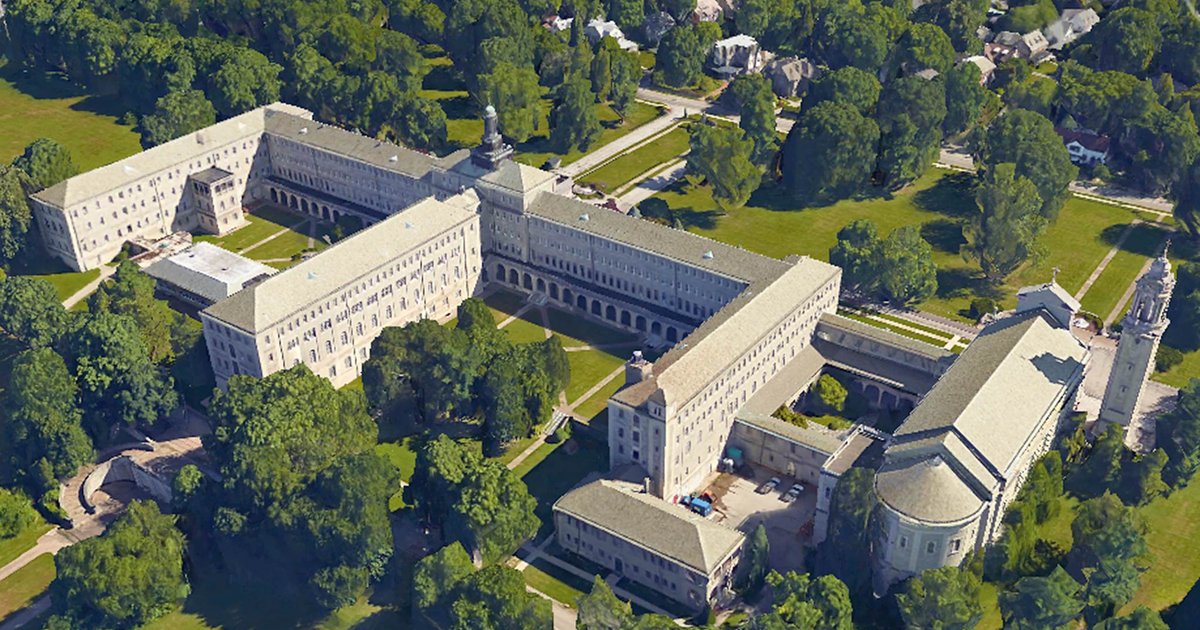
St. Charles Borromeo Seminary for the Archdiocese of Philadelphia, Pennsylvania

Hence the Roman Catholic Church has remained the bulwark of authoritarian conservatism, clericalism, and patriarchy with a hierarchical structure that “lords it over” the laity despite the efforts of two major Vatican Councils. Reforms resulting from both these councils began to slowly change the stance of the Church in most matters pertaining to the training of seminarians, religious, and laity. Parochial education on all levels continued the indoctrination of Catholics to defend the Faith from Protestantism but failed to provide adults with the necessary religious skills to live as a disciple in the 20th century. Each council contributed to the development of two major components of the Magisterium: the first to the development of Canon Law and the second to the composition of the Catechism of the Catholic Church. Other Vatican II impacts were realized in the Liturgy, Ministries, and parish life and structure. Women were allowed to be appointed or chosen as catechists, lectors, cantors, and Eucharistic ministers. Male or female business managers were then hired for most parishes at the recommendation of newly formed Parish Councils who convened regularly to offer advice and assistance to the pastor in his administration and care of the parish church and its numerous facilities.

Yet resistance to Vatican II began almost immediately after the council concluded. Some of the Faithful, as well as the clergy, resented the changes that brought an end to some of the regal accoutrements of the clergy,and hierarchy as well as  the celebration of the Liturgy. The cassock and suit was replaced by the black shirt and colar, the lace albs and expensive vestments and robes were modified. The “altar of sacrifice” had become the “Table of the Lord”, the “Chalice” was then referred to as the “Cup of Salvation”, the “Throne” of the celebrant was now the “Presider’s Chair” and modern architecture for new church buildings replaced Gothic structures of old. These changes upset Catholic traditionalists who preferred the old Church.

Under Pope Benedict XVI some of the liturgical language was changed back to its pre-Council form and the reigns were tightened on the clerical training in seminaries which had become more like the Catholic Universities than monastic enclaves to instill a separation from the secular world.

Today, the Catholic Church is facing a crisis. In many countries, Mass attendance is down and a growing number of young Catholics are leaving the church. In addition to these challenges, fewer and fewer men are willing to enter the priesthood and women to the religious life.This trend, which began long before the clergy sex abuse scandal, is raising questions as to whether or not the church needs to reconsider its insistence on a male, celibate priesthood.

And, of course, there are many other concerns that the church might want to address – for example, whether the 98 percent of practicing Catholics who use “artificial means” of contraception – meaning anything other than the rhythm method – are sinners.
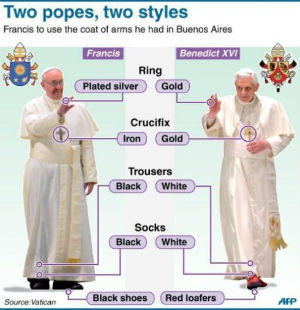
With the election of Pope Francis, a Jesuit, Vatican II teachings and pastoral attitudes were restored much to the dismay of many of the conservative laity and even Philanthropists including some clergy, bishops and cardinals. Pope Francis, for example, is well-known for decisions that emphasize simplicity and modesty. For example, he moved to a more simple apartment and is driven  in an ordinary Fiat automobile.  His compassion and empathy for those who don’t conform to Catholic teachings has been seen as acceptance of the non-conformists and caused some opposition.

Finally, the abuse scandal, the political involvement of the American Catholic Church in the last two elections, the strong opposition to women priests, and now the determination to prevent Pro-Choice politicians from receiving Communion could become the straw that breaks the camel’s back.

The need for more change and more lay participation in the leadership of the Catholic Church, and women priests is more obvious than ever but this could unleash a schism of great proportions. There seems to be a great divide in Catholcism reminiscent of the Protestant Reformation which took place in the 1500s. Since then Several Protestant Churches have even split from the main body of their denomination as well. This too could be the future of the Catholic Church. 

As the world turns the Churches too must turn to be more relevant to the people of new generations. Otherwise evangelization becomes ineffective to an ever changing society. 

Jesus was confronting the traditionalists of his day. He was introducing a new way of practicing the Jewish religion.

“No one sews a patch of unshrunk cloth on an old garment, for the patch will pull away from the garment, making the tear worse.Neither do people pour new wine into old wineskins. If they do, the skins will burst; the wine will run out and the wineskins will be ruined. No, they pour new wine into new wineskins, and both are preserved.” Mt 9:16-17

“Perhaps Jesus has part of the solution for the Catholic Church with his approach to solving controversy and division: “Not everyone who says to me, ‘Lord, Lord,’ will enter the kingdom of heaven, but only the one who does the will of my Father who is in heaven.” Mt 7:21 and  

“Beware of false prophets. They come to you in sheep’s clothing, but inwardly they are ravenous wolves. By their fruit you will recognize them. Are grapes gathered from thornbushes, or figs from thistles? Likewise, every good tree bears good fruit, but a bad tree bears bad fruit.… Mt 7:16-17

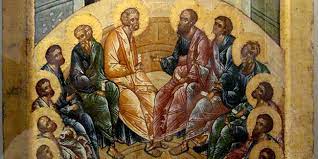
The Church, the Body of Christ, the People of God, need another Pentecost. The old must die and that can be hard and even horrific as was the crucifixion. But the resurrection can only happen after the old dies. The uncertainty of our times causes much confusion and even doubt. Yet Jesus has the answer.

“Amen, amen, I say to you, whoever believes in me will do the works that I do, and will do greater ones than these, because I am going to the Father” (John 14:12). “I will ask the Father, and he will give you another advocate to be with you always, the Spirit of truth, which the world cannot accept, because it neither sees nor knows it. But you know it, because it remains with you, and will be in you. I will not leave you orphans; I will come to you. In a little while the world will no longer see me, but you will see me, because I live and you will live. On that day you will realize that I am in my Father and you are in me and I in you.” 

Keep the Faith BUT share it as well!

Posted in Ecclesiology | 1 Comment

Who Asked for Your “Two Cents”?

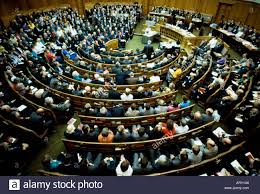
The Church did! We’ve all heard the expression, “When I want your two cents, I’ll ask for it.” This of course is referring to our opinion. That is, exactly what the early Church wanted during the New Testament times. Well, not “exactly” because Christian communities always consulted those who followed Jesus which implied that the disciples were relying on more than their own opinion but rather on the Spirit to inspire them with the wisdom of God. Their “sense of faith” or Sensus Fidei was needed for input and decision making much like the Church uses synods of bishops and councils to help with doctrines, creeds, and worship rituals and norms. In the Acts of the Apostles, we read: “In those days when the number of disciples was increasing, the Hellenistic Jews among them complained against the Hebraic Jews because their widows were being overlooked in the daily distribution of food. So the Twelve gathered all the disciples together and said, “It would not be right for us to neglect the ministry of the word of God in order to wait on tables. Brothers and sisters, choose seven men from among you who are known to be full of the Spirit and wisdom. We will turn this responsibility over to them and will give our attention to prayer and the ministry of the word.” It’s obvious from that passage that everyone had input into the Church’s administration of ministries and duties in conjunction with “The Way of Jesus”.

Another example concerns the early Church dispute about whether or not to mandate the circumcision of the gentiles who were becoming followers of Jesus. Paul and Barnabus wanted help with their ministry in Antioch to address this issue.  “Then the apostles and elders, with the whole church, decided to choose some of their own men and send them to Antioch with Paul and Barnabas.” Acts 15: 22

In the first five centuries, the characterization of a local church as “apostolic” pointed to its whole life: its Scriptures, sacraments and liturgy, authorized leaders, moral norms, ecclesiastical discipline and polity, interaction with pagan culture, socialization of its members, and its explicit beliefs. Historically, the common teaching in the Church saw an active role of all the faithful in determining Christian belief. The whole community attested to the apostolicity of the faith. Though the bishops increasingly taught with authority and defined the emerging orthodox synthesis at synods and general councils, the concrete life of the community was always considered and the faithful were routinely consulted.

Two theological terms have come to express the understanding that all believers participate in elaborating Christian truth: sensus fidei and sensus fidelium. The first refers to the Christian’s possession of the fundamental truth of his faith. The second refers to his role in actively defending and elaborating that faith.

So, yes, the Church wants your “two cents” or wants to get a “sense” of what you believe in accordance to the Spirit’s inspiration based on the Word of God. It is NOT your opinion but your faith- your confidence in the guidance of the Spirit.

The belief of the faithful proved decisive in determining the canon of Scripture, the full and unquestioned divinity of Christ, Mary’s virginity and her title of Mother of God, baptismal theory and practice, the necessity of grace, the veneration of the saints, etc. The faithful played no minor role in helping to decide doctrines as well as matters of praxis.

The current authoritarian, patriarchal structure of clericalism in the Church, with deacons, priests, and bishops, all males, as the clergy and adding honorary positions or titles of monsignor, or “cardinal” wasn’t exactly what Jesus or the early Church intended.

Let’s review the actual structure of the early Church communities of the disciples of Jesus. First, we go the Acts 2 to understand the communal aspect of the Church. “They devoted themselves to the apostles’ teaching and to fellowship, to the breaking of bread and to prayer. Everyone was filled with awe at the many wonders and signs performed by the apostles. All the believers were together and had everything in common. They sold property and possessions to give to anyone who had need.  Every day they continued to meet together in the temple courts. They broke bread in their homes and ate together with glad and sincere hearts, praising God and enjoying the favor of all the people. And the Lord added to their number daily those who were being saved.”  Acts 2: 42-47

Jerusalem had an early Christian community, which was led by James the Just, Peter, and John. According to Acts 11:26, Antioch was where the followers were first called Christians. Peter was later martyred in the Church of Rome, the capital of the Roman Empire. Then, as now, there were disputes about the leadership in the Church and Paul went to Corinth to address such a debate.

“My brothers and sisters, some from Chloe’s household have informed me that there are quarrels among you. What I mean is this: One of you says, “I follow Paul”; another, “I follow Apollos”; another, “I follow Cephas”; still another, “I follow Christ.” Is Christ divided? Was Paul crucified for you? Were you baptized in the name of Paul?” 1Cor 12  “For when one says, “I follow Paul,” and another, “I follow Apollos,” are you not being merely human” (1 Cor 3:5), because “What then is Apollos? What is Paul? Servants through whom you believed, as the Lord assigned to each” (1 Cor 3:6)? Paul’s conclusion is that we are nothing but vessels that God uses to bring people to Christ, or as Paul said, “I planted, Apollos watered, but God gave the growth” (1 Cor 3:6).

The influence of the faithful was somewhat diminished in the Latin Church after the fall of the Roman empire in the West, but it continued to exercise an active role in the Church’s life. By then, Church had adopted the structure of the Roman Empire to avoid any incrimination that it was reactionary or a part of any outside group that chose to oppose Rome. The early Church reflected, or ‘mimicked’, the organization of the Empire, with the ecclesiastical structure being headed by Constantine, who appointed the bishops. Historically, the church changed its governance structures to match changes in civil society.  

If we go back to the New Testament times and search the scriptures we can conclude that: the writers of the New Testament never referred to anyone as a “priest” except for Jesus, There was mention of a priesthood but it pertained to the whole community which was the Body of Christ. For Peter wrote: “You are a chosen people, a royal priesthood, a holy nation, God’s special possession, that you may declare the praises of him who called you out of darkness into his wonderful light.” 1Pt 2:9

There were various positions or ministries that each community or Church needed and therefore appointed members to meet those needs: “Here are some of the parts God has appointed for the church: first are apostles, second are prophets, third are teachers, then those who do miracles, those who have the gift of healing, those who can help others, those who have the gift of leadership, those who speak in unknown languages.”1Cor 12:28 and again in Ephesians 4:11- “So Christ himself gave the apostles, the prophets, the evangelists, the pastors, and teachers, to equip his people for works of service, so that the body of Christ may be built up”.

There were two titles or positions that the early Church created. One was the presbyter or elder and the other was the episkopos or overseer. The former position was filled by each community choosing one and the latter was usually designated by elders from various representative communities. Today, we might call them pastors, and bishops in that order. 

Though the influence of the faithful was somewhat diminished in the Latin Church after the fall of the Roman empire in the West, it continued to exercise an active role in the Church’s life. However, the struggle to eradicate the practice of lay investiture, the reforms of Gregory VII, and a general tendency toward viewing social reality in more juridical categories and to impose more institutional forms on the life in the Church resulted in a depreciation of the gifts and contributions of the laity.

Martin Luther posts the Ninety-five Theses, propositions for debate concerned with the question of indulgences

By the Reformation, the clergy were so powerful and authoritarian that many protested and Protestantism was born. With the exception of the Catholic, Orthodox and Anglican Churches, most denominations rely on the elders of the Church to recruit and appoint pastors and bishops. In the Catholic Church, the laity has no input or contributing say in the process.

The second Vatican council’s focus on what the Church itself was and how it related to the larger world necessarily involved a deeper appreciation of all believers in the Church. The laity in particular needed to be reminded of their inherent dignity and of their contribution to the building up of God’s kingdom. The council spoke of all the faithful participating in the offices of Christ as prophet, priest, and king. Baptism into Christ means that each believer can claim to exercise these offices. The council also spoke of the Holy Spirit imparting the gift of faith and bestowing charisms on each Christian. A positive, active, and dynamic understanding of the believer emerged. The teaching of the sensus fidelium in particular helped clarify the prophetic duty of the believer to proclaim the word of God. The laity was challenged to deepen their understanding of the faith by prayer, study, discussion, and committed action. The ambit of their intellectual penetration is not restricted solely to secular matters, though in those matters, obviously the laity have an especial contribution to make and in such matters they speak with particular authority. On matters of faith and morals, too, they are called to fulfill their prophetic task in communion with their leaders.

In October, Pope Francis will open a three-year synodal journey with three phases (diocesan, continental, universal) of consultations and discernment, culminating with the assembly in October 2023 in Rome. “One listening to the others; and all listening to the Holy Spirit.” says  Salvatore Cernuzio,from the Vatican News Office. “Each particular Church of the five continents, following a three-year itinerary divided into three phases: diocesan, continental and universal and 

Scheduled for October 2023 in Rome.

Each bishop, before October 2021, will appoint a diocesan representative as a point of reference and liaison with the Bishops’ Conference; the Conference, in turn, will appoint a representative or team to coordinate with the General Secretariat of the Synod”. ”The diocesan discernment will culminate in a “Pre-Synodal Meeting.” The contributions will be sent to their own Episcopal Conference. The bishops, gathered in assembly for a period of discernment, will make a synthesis which they will send to the General Secretariat of the Synod. This first stage will be completed by April 2022. 

Thus, the first year of the three-year Synod will be complete. “The next phase will focus on the Church dioceses in each Continent. The aim is to engage in a dialogue on the Instrumentum laboris. At the end of their discussions, each continental grouping will draft a final document, which they will send to the General Secretariat in March 2023.” The Secretariat will then draft a second Instrumentum laboris, based on the responses. The publication is planned for June 2023, the Universal phase will be held by the bishops of the world in Rome and the synodal journey will culminate in October 2023 with the celebration of the Assembly of Bishops in Rome.

The Pope has appointed a woman as an undersecretary to the Synod of Bishops for the first time. Sister Nathalie Becquart, who is from France, will have voting rights in the body, which advises the pontiff and debates some of the most controversial issues in the Roman Catholic Church. Sr. Becquart has worked with the synod as a consultant since 2019. The body’s secretary-general, Cardinal Mario Grech, said the appointment showed that “a door has opened”.

“If we find ourselves alienated from the sensus fidei as it has been understood through the centuries, there is surely work to be done. But, not all the work rests with the hierarchy. This accessible document from The Congregation for the Doctrine of the Faith issued an important document that helps us understand our work as lay faithful and the first task, surely, is to make sure that we are, literally, faithful, full of faith.” writes Michael Sean Winters in the NCR Jun 30, 2014

SENSUS FIDEI

IN THE LIFE OF THE CHURCH

http://www.vatican.va/roman_curia/congregations/cfaith/cti_documents/rc_cti_20140610_sensus-fidei_en.html

(2014)

CONTENTS

Introduction

Chapter One: The sensus fidei in Scripture and Tradition

1. Biblical teaching

a) Faith as response to the Word of God

b) The personal and ecclesial dimensions of faith

c) The capacity of believers to know and witness to the truth

2. The development of the idea, and its place in the history of the Church

a) Patristic period

b) Medieval period

c) Reformation and post-Reformation period

d) 19th century

e) 20th century

Chapter Two: The sensus fidei fidelis in the personal life of the believer

1. The sensus fidei as an instinct of faith

2. Manifestations of the sensus fidei in the personal life of believers

Chapter Three: The sensus fidei fidelium in the life of the Church

1. The sensus fidei and the development of Christian doctrine and practice

a) Retrospective and prospective aspects of the sensus fidei

b) The contribution of the laity to the sensus fidelium

2. The sensus fidei and the magisterium

a) The magisterium listens to the sensus fidelium

b) The magisterium nurtures, discerns and judges the sensus fidelium

c) Reception

3. The sensus fidei and theology

a) Theologians depend on the sensus fidelium

b) Theologians reflect on the sensus fidelium

4. Ecumenical aspects of the sensus fidei

Chapter Four: How to discern authentic manifestations of the sensus fidei

1. Dispositions needed for authentic participation in the sensus fidei

a) Participation in the life of the Church

b) Listening to the word of God

c) Openness to reason

d) Adherence to the magisterium

e) Holiness – humility, freedom and joy

f) Seeking the edification of the Church

2. Applications

a) The sensus fidei and popular religiosity

b) The sensus fidei and public opinion

c) Ways of consulting the faithful

Conclusion

123. Problems arise when the majority of the faithful remain indifferent to doctrinal or moral decisions taken by the magisterium or when they positively reject them. This lack of reception may indicate a weakness or a lack of faith on the part of the people of God, caused by an insufficiently critical embrace of contemporary culture. But in some cases, it may indicate that certain decisions have been taken by those in authority without due consideration of the experience and the sensus fidei of the faithful, or without sufficient consultation of the faithful by the magisterium.[137]

Let your pastor, your bishop and even the Pope @Pontifex know your “sense of faith” that you have prayed over in consultation with your reflection on the Word of God.

The Early Church
The Church in the 21st Century
Posted in Church History, Discipleship, Ecclesiology | Leave a comment

Your Seat at The Table Is Ready!

I invite you to the table of God- the Trinity. Picture yourself sitting at the space in the front, facing the persons of the Trinity. 

As you sit there, the host gives you this menu or explanation for the meal. 

The Trinity (The Hospitality of Abraham) is an icon created by Russian painter Andrei Rublev in the 15th century

This icon takes as its subject the mysterious story where Abraham receives three visitors as he camps by the oak of Mamre. (Genesis 18:1-8) He serves them a meal. As the conversation progresses he seems to be talking straight to God, as if these ‘angels’ were in some way a metaphor for the three persons of the Trinity. 

In Rublev’s representation of the scene, the three gold-winged figures are seated around a white table on which a golden, chalice-like bowl contains a roasted lamb. In the background of the picture, a house can be seen at the top left and a tree in the center. Less distinctly, a rocky hill lies in the upper right corner. The composition is a great circle around the table, focusing the attention on the chalice/bowl at the center, which reminds the viewer inescapably of a table or altar at Communion. On one level this picture shows three angels seated under Abraham’s tree, but on another it is a visual expression of what the Trinity means.

What is the nature of God, and how do we approach God?

 Reading the picture from left to right, we see the Father, the Son, and the Holy Spirit.

The Colors Rublev gives each person of the Trinity different clothing. 

On the right, the Holy Spirit has a garment of the clear blue of the sky, wrapped over with a robe of a fragile green. So the Spirit of creation moves in sky and water, breathes in heaven and earth. All living things owe their freshness to his touch. 

The Son has the deepest colors; a thick heavy garment of the reddish-brown of earth and a cloak of the blue of heaven. In his person he unites heaven and earth, the two natures are present in him, and over his right shoulder (the Government shall be upon his shoulder) there is a band of gold shot through the earthly garment, as his divinity suffuses and transfigures his earthly being. 

The Father seems to wear all the colors in a kind of fabric that changes with the light, that seems transparent, that cannot be described or confined in words. And this is how it should be. No one has seen the Father, but the vision of him fills the universe. The wings of the angels or persons are gold. 

Their seats are gold. The chalice in the center is gold, and the roof of the house. Whether they sit, whether they fly, all is perfect, precious, and worthy. 

The Father looks forward, raising his hand in blessing to the Son. It is impossible to tell whether he looks up at the Son or down to the chalice on the table, but his gesture expresses a movement towards the Son. This is my Son, listen to him… 

The hand of the Son points on, around the circle, to the Spirit. In this simple array we see the movement of life towards us, The Father sends the Son, the Son sends the Spirit.

Life flows clockwise around the circle. And we complete the circle. As the Father sends the Son, as the Son sends the Holy Spirit, so we are invited and sent to complete the circle of the Godhead with our response. 

And we respond to the movement of the Spirit who points us to Jesus. And he shows us the Father in whom all things come to fruition. This is the counter-clockwise movement of our lives, in response to the movement of God. And along the way are the three signs at the top of the picture, the hill, the tree, and the house. 

The Spirit touches us, even though we do not know who it is that is touching us. He leads us by ways we may not be aware of, up the hill of prayer. It may be steep and rocky, but the journeying God goes before us along the path. It leads to Jesus, the Son of God, and it leads to a tree, the symbol of the cross.

 Each person holds a staff, which is so long it cuts the picture into sections. Why should beings with wings that can fly like the light, have need of a staff for their journey? Because we are on a journey and these three persons enter into our journey, our slow movement across the face of the earth. Their feet are tired from traveling. God is with us in the weariness of our human road. The traveler God sits down at our ordinary tables and spreads them with a hint of heaven. 

The Table 

The table or altar lies at the center of the picture. It is at once the place of Abraham’s hospitality to the angels, and God’s place of hospitality to us. 

That ambiguity lies at the heart of communion, at the heart of worship. As soon as we open a sacred place for God to enter, for God to be welcomed and adored, it becomes his place. It is we who are welcomed, it is we who must ‘take off our shoes’ because of the holiness of the ground. Contained in the center of the circle, a sign of death. The lamb, killed. The holy meal brought to the table. All points to this space, this mystery: within it, everything about God is summed up and expressed, his power, his glory, and above all his love. And it is expressed in such a way that we can reach it. For the space at this table is on our side. 

We are invited to join the group at the table and receive the heart of their being for ourselves. We are invited to complete the circle, to join the dance, to complete the movements of God in the world by our own response. 

Below the altar a rectangle marks the holy place where the relics of the martyrs were kept in a church. It lies before us. It invites us to come into the depth and intimacy of all that is represented here. 

Come follow the Spirit up the hill of prayer.

Come, live in the shadow of the Son of God, rest yourself beneath his tree of life. 

Come, journey to the home, prepared for you in the house of your Father.

The table is spread, the door is open

Eat.

Reflect-Meditate-Contemplate

Posted in Sacramental Celebration, Spirituality, Theology | Leave a comment

Are Catholics Confused about Grace?

Catholics and many Protestants are confused about GRACE! Why? Because they believe that GRACE is the Divine influence which operates in humans to regenerate and sanctify, to inspire virtuous impulses, and to impart strength to endure trial and resist temptation; and as an individual virtue or excellence of divine origin. That’s a lot to digest. Do I receive GRACE by going to Church? Doing volunteer work? That depends, according to many theologians, preachers, denominations of Christianity, and other religions.

Patristic theologians, known as the Fathers of the Church, wrote tomes about grace because there were so many controversies and definitions. For example, Pelagius, a British monk who preached in fifth-century Rome declared that Christians could earn their way into Heaven by doing good deeds, without the need of divine grace.

After Augustine refuted the teachings of Pelagius, some claimed that humans can simply be open to the Divine without God’s grace; and that Grace is retained through one’s efforts, without further grace from God; and that natural human effort alone can give one some claim to receiving grace, though not strictly merit it. One could debate this topic for a lifetime but maybe there is a simple answer. Read on!

So how does one obtain GRACE? Catholics may recall the basic definition they learned in parochial school from the Baltimore catechism.  “A sacrament is an outward sign instituted by Christ to give grace.” Sounds almost like a vending machine. Sorry, but when one sees so many people attending worship services lined up to receive Communion in the hand one has to wonder if that’s GRACE let alone Jesus!

Within Christianity, there are different concepts of how grace is attained. In particular, Catholics and Reformed Protestants understand the attainment of grace in substantially different ways. It has been described as “the watershed that divides Catholicism from Protestantism, Calvinism from Arminianism, modern liberalism from conservatism”.

Nowadays the Catholic Church refined its definition of GRACE but not very succinctly.

“We discover that “grace is favor, the free and undeserved help that God gives us to respond to his call to become children of God, adoptive sons, partakers of the divine nature and of eternal life”. Grace is a participation in the life of God, which is poured unearned into human beings, whom it heals of sin and sanctifies. The means by which God grants grace are many.”

“Our justification comes from the grace of God. Grace is favor, the free and undeserved help that God gives us to respond to his call to become children of God, adoptive sons, partakers of the divine nature and of eternal life.” 1996 CCC

“Grace is first and foremost the gift of the Spirit who justifies and sanctifies us. But grace also includes the gifts that the Spirit grants us to associate us with his work, to enable us to collaborate in the salvation of others and in the growth of the Body of Christ, the Church. There are sacramental graces, gifts proper to the different sacraments.” 2003 CCC 

“There are furthermore special graces, also called charisms after the Greek term used by St. Paul and meaning “favor,” “gratuitous gift,” “benefit.” Whatever their character – sometimes it is extraordinary, such as the gift of miracles or of tongues – charisms are oriented toward sanctifying grace and are intended for the common good of the Church. They are at the service of charity which builds up the Church.”  2003 CCC

“Among the special graces ought to be mentioned the graces of state that accompany the exercise of the responsibilities of the Christian life and of the ministries within the Church: Having gifts that differ according to the grace given to us, let us use them: if prophecy, in proportion to our faith; if service, in our serving; he who teaches, in his teaching; he who exhorts, in his exhortation; he who contributes, in liberality; he who gives aid, with zeal; he who does acts of mercy, with cheerfulness.” 2004 CC

“Since it belongs to the supernatural order, grace escapes our experience and cannot be known except by faith. We cannot, therefore, rely on our feelings or our works to conclude that we are justified and saved.” However, according to the Lord’s words “Thus you will know them by their fruits” – reflection on God’s blessings in our life and in the lives of the saints* offers us a guarantee that grace is at work in us and spurs us on to an ever greater faith and an attitude of trustful poverty.” 2005 CCC

   *Paul writes to the “saints at Ephesus” Eph1:1. In the New Testament, the word is used to refer to Christians generally, but the name survived as a general title for Christians only through the second century. Then the Fathers of the Church declared sainthood synonymous with martyrdom” since it was such in the book of Revelation: “And I saw the woman drunken with the blood of the saints, and with the blood of the martyrs of Jesus: and when I saw her, I wondered with great admiration.: Rev 17:6 

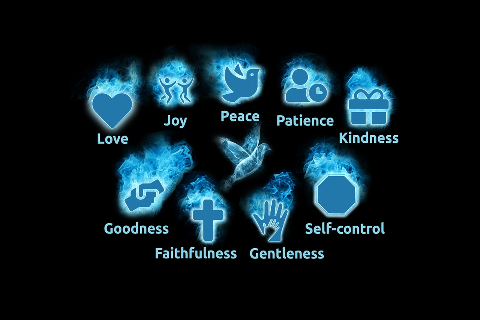
This then resulted in the word becoming an “honorific title for confessors, martyrs and ascetics no longer to those of us who are known by our fruits: “But the fruit of the Spirit is love, joy, peace, forbearance, kindness, goodness, faithfulness, gentleness and self-control. Against such things there is no law.” Gal 5:22-23

Are you getting the sense that today, that some theologians preachers, priests and bishops, are deciding who gets grace and who doesn’t, who’s a saint and who isn’t? Many show the fruits of their labors to be very similar to those listed above. President Biden displays the fruits of the Spirit as a good, decent Catholic yet he can’t receive Communion because he respects the First and Fourteenth Amendments to America’s Constitution and won’t and can’t impose his religious beliefs onto the people of America, many of whom believe differently or are not even religious. Is the Church saying that if you belong to the Democratic party you are a sinner? I ask therefore, If you belong to the Republican party are you a racist? Politics and religion do not mix well. Haven’t we learned that from the last two thousand years of religious wars, and persecutions? Wasn’t that one major reason why people migrated from Europe to America?

Recently the Associated Press issued a news story with the following introduction:

A Wisconsin bishop has taken the unusual step of removing a defiant priest from the ministry after he made a series of divisive remarks about politics and the pandemic. The priest removed was the Rev.Altman who rose to prominence ahead of the 2020 presidential election with a fiery YouTube video in which he said Catholics can’t be Democrats and that anyone who supports Democrats will burn in hell.

“Requests that a priest resign aren’t uncommon but they rarely lead to such a high-profile refusal, Catholic observers say. One of the few such cases in the U.S. came in 2002, when a priest in the Archdiocese of Boston refused to step down over an accusation that he sexually abused a child three decades earlier. The Rev. D. George Spagnolia took his case to the Vatican but was unable to overturn his suspension. He died in 2008. More recently, the Rev. Frank Pavone, an anti-abortion activist who heads Priests for Life, appealed to the Vatican over restrictions placed on his ministry in 2011 by his bishop in Amarillo, Texas. Pavone succeeded in getting the restrictions eased, relocated away from Texas and remains active with Priests for Life.” writes Todd Richmond  for AP

Again, the Catholic Church concludes that “The grace of Christ is the gratuitous gift that God makes to us of his own life, infused by the Holy Spirit into our soul to heal it of sin and to sanctify it. It is the sanctifying or deifying grace received in Baptism. It is in us the source of the work of sanctification” 1919 CCC

AS if the above is not enough, we also must distinguish between many kinds of GRACE and this gets tricky.

There’s ACTUAL grace-Temporary supernatural intervention by God to enlighten the mind or strengthen the will to perform supernatural actions that lead to heaven. Actual grace is therefore a transient divine assistance to enable man to obtain, retain, or grow in supernatural grace and the life of God. There’s Sanctifying grace which is the gratuitous gift of his life that God makes to us; it is infused by the Holy Spirit into the soul to heal it of sin and to sanctify it.

Sanctifying grace makes us “pleasing to God.” Charisms, special graces of the Holy Spirit, are oriented to sanctifying grace and are intended for the common good of the Church. God also acts through many actual graces, to be distinguished from habitual grace which is permanent in us.

You may think that this all is without controversy but in the history of the Church there was much contention and disagreement about many teachings on grace in particular: 

“The actual grace to which free consent is given by the will so that the grace produces its divinely intended effect. In the controversy between the Dominicans [led by Báñez (1528-1604)] and the Jesuits [led by Molina (1525-1600)] there was no agreement on what precisely causes an actual grace to become efficacious. In the Báñezian theory, the efficacy of such grace depends on the character of the grace itself; in the Molinist theory, it depends on the fact that it is given under circumstances that God foresees to be congruous with the dispositions of the person receiving the grace. In every Catholic theory, however, it is agreed that efficacious grace does not necessitate the will or destroy human freedom.” (Catholic Dictionary)

During the time of Jesus, you will recall that he challenged the Pharisees and Sadducees because they had devised some 613 mitzvahs or laws to supplement the Ten Commandments! Jesus was forthright in ignoring many of them since they prevented people from expressing the fruits of the Spirit mentioned above. For example the Tohorah, in Judaism, was the system of ritual purity practiced by Israel. Purity (tohorah) and uncleanness (tumʾah) carry forward Pentateuchal commandments that Israel—whether eating, procreating, or worshiping God in the Temple—must avoid sources of contamination, the principal ones of which is the corpse, the leper, and the outcasts, all of whom Jesus embraced walking and talking with them and through healing, dining with them. What would he say to the Catholic bishops today??

Like the Pharisees,  the Catholic Church Magisterium has devised Canon Laws and the Catechism of the Catholic Church to supplement the Commandments, and its Magisterial Doctrines. 

My point in all of this is quite simple. How much GRACE do we need? What happened to the gifts of the Spirit? The seven gifts of the Holy Spirit are an enumeration of seven spiritual gifts originating from patristic authors, later elaborated by five intellectual virtues and four other groups of ethical characteristics. The gifts are: wisdom, understanding, counsel, fortitude, knowledge, piety, and fear of the Lord. If we receive these gifts evidenced by the fruits of the Spirit, are we not graced? Are we not closer to the Divine than say a racist, bigot, compulsive liar? Maybe many of the Catholic bishops need to rethink their theology and consider listening to the Sensus Fidei which will be the topic of another post.

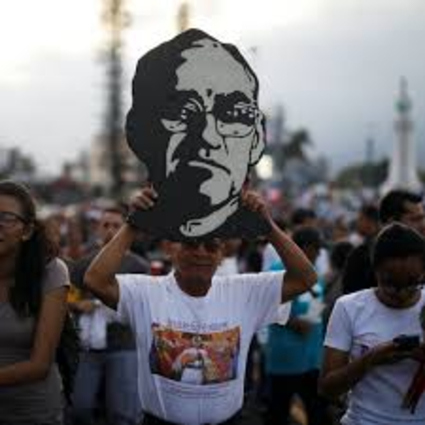
When Archbishop Óscar Romero spoke out for the poor of El Salvador, he knew he was putting his own life in danger, and he was strengthened by the courage that is a gift of the Holy Spirit.

When Mrs. Augusta Gervay and Father Emilian Novak ran a workshop that produced baptismal certificates used to save the lives of Jews during the Holocaust, they were endangering their own lives and were strengthened by the courage that is a gift of the Holy Spirit.

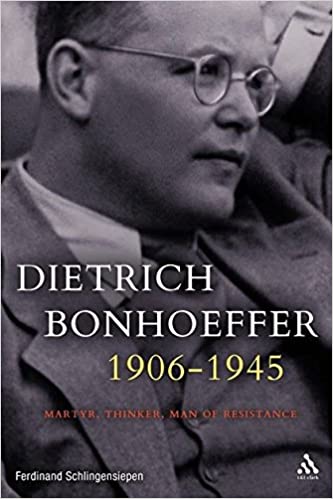
Dietrich Bonhoeffer,was a German Lutheran pastor, and theologian and the author of The Cost of Discipleship. He wrote this about GRACE.

 “Cheap grace means grace sold on the market like cheapjacks’ wares. The sacraments, the forgiveness of sin, and the consolations of religion are thrown away at cut prices. Grace is represented as the Church’s inexhaustible treasury, from which she showers blessings with generous hands, without asking questions or fixing limits. Grace without price; grace without cost! The essence of grace, we suppose, is that the account has been paid in advance; and, because it has been paid, everything can be had for nothing. Since the cost was infinite, the possibilities of using and spending it are infinite. What would grace be if it were not cheap?..

Cheap grace is the preaching of forgiveness without requiring repentance, baptism without church discipline, Communion without confession, absolution without personal confession. Cheap grace is grace without discipleship, grace without the cross, grace without Jesus Christ, living and incarnate.Costly grace is the treasure hidden in the field; for the sake of it a man will go and sell all that he has. It is the pearl of great price to buy which the merchant will sell all his goods. It is the kingly rule of Christ, for whose sake a man will pluck out the eye which causes him to stumble; it is the call of Jesus Christ at which the disciple leaves his nets and follows him.

Costly grace is the gospel which must be sought again and again, the gift which must be asked for, the door at which a man must knock.

Such grace is costly because it calls us to follow, and it is grace because it calls us to follow Jesus Christ. It is costly because it costs a man his life, and it is grace because it gives a man the only true life. It is costly because it condemns sin, and grace because it justifies the sinner. Above all, it is costly because it cost God the life of his Son: “ye were bought at a price,” and what has cost God much cannot be cheap for us. Above all, it is grace because God did not reckon his Son too dear a price to pay for our life, but delivered him up for us. Costly grace is the Incarnation of God.”

Bonhoeffer was known for his staunch resistance to the Nazi dictatorship, including vocal opposition to Hitler’s euthanasia program and genocidal persecution of the Jews. He was arrested in April 1943 by the Gestapo and imprisoned at Tegel prison for one and a half years. Later, he was transferred to Flossenbürg concentration camp.

After being accused of being associated with the 20 July plot to assassinate Adolf Hitler, he was quickly tried along with other accused plotters, including former members of the Abwehr (the German Military Intelligence Office), and then hanged on 9 April 1945 as the Nazi regime was collapsing. Bonhoeffer was sentenced to death on 8 April 1945 by SS judge Otto Thorbeck at a drumhead court-martial without witnesses, records of proceedings or a defense in Flossenbürg concentration camp.He was executed there by hanging at dawn on 9 April 1945. Bonhoeffer was stripped of his clothing and led naked into the execution yard where he was hanged with six others.”

Blessed are the poor in spirit, for theirs is the kingdom of heaven

Blessed are those who mourn, for they will be comforted.

Blessed are the meek, for they will inherit the earth

Blessed are those who hunger and thirst for righteousness, for they will be filled.

Blessed are the merciful for they will be shown mercy.

Blessed are the pure in heart, for they will see God.

Blessed are the peacemakers, for they will be called children of God.

Blessed are those who are persecuted because of righteousness, for theirs is the kingdom of heaven.

Posted in Catechesis, Catholic Teachings, Discipleship, Sacramental Celebration, Spirituality | 1 Comment

Whose Church Is It Anyway?

Understanding the origins of the various concepts and titles for the community of disciples.

In the Catholic tradition, the followers of Jesus are referred to as The Body of Christ, The People of God, The Faithful, The Flock, and the Church(ecclesia). These nomenclatures have been around for almost as long as the nomenclatures, The Way, and Christian. 

As used by Saint Paul in his letter to the Ephesians, The Body of Christ refers to all individuals who “heard the word of truth, the gospel of your salvation, believed in him, were sealed with the promised Holy Spirit”  “are being built together into a dwelling place for God by the Spirit” are “joined and held together by every joint with which it is equipped, when each part is working properly, makes the body grow so that it builds itself up in love”.

And in his first letter to the Corinthians he writes rather extensively about  the unity and diversity in the Body:

“Just as a body, though one, has many parts, but all its many parts form one body, so it is with Christ. For we were all baptized by one Spirit so as to form one body—whether Jews or Gentiles, slave or free—and we were all given the one Spirit to drink.  Even so the body is not made up of one part but of many.

Now if the foot should say, “Because I am not a hand, I do not belong to the body,” it would not for that reason stop being part of the body. And if the ear should say, “Because I am not an eye, I do not belong to the body,” it would not for that reason stop being part of the body. If the whole body were an eye, where would the sense of hearing be? If the whole body were an ear, where would the sense of smell be?  But in fact God has placed the parts in the body, every one of them, just as he wanted them to be. If they were all one part, where would the body be? As it is, there are many parts, but one body.

 The eye cannot say to the hand, “I don’t need you!” And the head cannot say to the feet, “I don’t need you!” On the contrary, those parts of the body that seem to be weaker are indispensable, and the parts that we think are less honorable we treat with special honor. And the parts that are unpresentable are treated with special modesty, while our presentable parts need no special treatment. But God has put the body together, giving greater honor to the parts that lacked it, so that there should be no division in the body, but that its parts should have equal concern for each other.  If one part suffers, every part suffers with it; if one part is honored, every part rejoices with it.

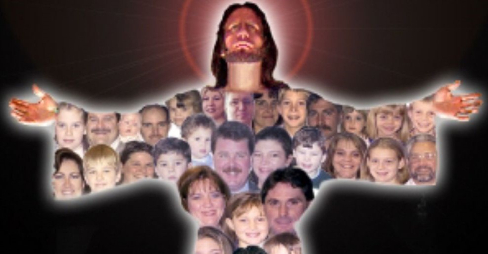
Now you are the body of Christ, and each one of you is a part of it. 

Now you are the body of Christ, and each one of you is a part of it.  And God has placed in the church first of all apostles, second prophets, third teachers, then miracles, then gifts of healing, of helping, of guidance, and of different kinds of tongues. Are all apostles? Are all prophets? Are all teachers? Do all work miracles?  Do all have gifts of healing? Do all speak in tongues? Do all interpret?  Now eagerly desire the greater gifts”

It wasn’t until much later that the Roman Catholic theologians use the term “Mystical Body of Christ” to stress the powerful manifestation of the divine authority of certain parts of the Body of Christ first made popular from Pius XII’s letter: Mystici Corporis Christi, in 1943. “The encyclical builds on a theological development in the 1920s and 1930s in Italy, France, Germany and England, which all re-discovered the Pauline concept of the Mystical Body of Christ. In 1936, Emile Mersch had warned of some false mysticism’s being advanced with regard to the mystical body, and his history of this topic was seen as influencing the encyclical On 18 January 1943, five months before the promulgation of Mystici corporis, Archbishop Conrad Gröber of Fribourg promulgated a letter in which he addressed the docetic tendencies of some mystical body theology (to separate the spiritual and the material elements in man). Timothy Gabrielli saw Pius’ emphasis on the church as a perfect society on earth as an attempt to save the mystical body theology, with its many theological, pastoral, and spiritual benefits, from the danger of docetism, broadly taken as the belief that Jesus only seemed to be human, and that his human form was an illusion.”

(So, a simple analogy used by Paul to express the unity of all who follow Jesus and how each is important becomes a theological Church doctrine that gives more power to the clergy and especially the Pope.)

“Yet the encyclical teaches that both laypeople and the leadership have a role to play in the Church. “Lay people are at the forefront of the Church, and have to be aware of ‘being the Church’, not just ‘belonging to the Church’.” (In other words, the laity are the workers and bear the burden of “being the Light to the World while at the same time, the Pope and bishops are responsible for providing leadership for all the faithful but don’t always practice what they preach since they lived an opulent life style for most of the Catholic Church’s history even up to the present. Pope Francis has tried to set an example of downsizing residences and other accouterments that reflect opulence and entitlement. Together, the letter states, “they are the Church and work for the good of the Church.”

In 1947, Pius XII later (threw a bone to the laity” issued the Apostolic Constitution Provida Mater Ecclesia, which allowed lay people to form their own secular communities, and establish them within a newly established Canon Law framework which incorporated the following as well.

NOW we get to the designation of Power: the Apostles and bishops

“The encyclical states that Christ, while still on earth, instructed by precept, counsel and warnings “in words that shall never pass away, and will be spirit and life” to all men of all times. He conferred a triple power on His Apostles and their successors, to teach, to govern, to lead men to holiness, making this power, defined by special ordinances, rights, and obligations, the fundamental law of the whole Church. God governs directly and guides personally the Church which He founded.” ( Really? As far as I can surmise, apostles [from apostolos ‘messenger’, from apostellein ‘send forth’] were those SENT to evangelize. They were NOT ordained by Jesus!)

Pius XII tried to justify his statement or proclamation by “quoting Proverbs 21:1 noting that God reigns within the minds and hearts of men, and bends and subjects their wills to His good pleasure, even when rebellious”. (What happened to Free Will and conscience?)

“Mystici corporis requests the faithful to love their Church and to always see Christ in her, especially in the old and sick members. They must accustom themselves to see Christ Himself in the Church. For it is Christ who lives in His Church, and through her, teaches, governs, and sanctifies; it is Christ also who manifests Himself differently in different members of His society.” (Finally a reference to Pauls, analogy!) It goes on:

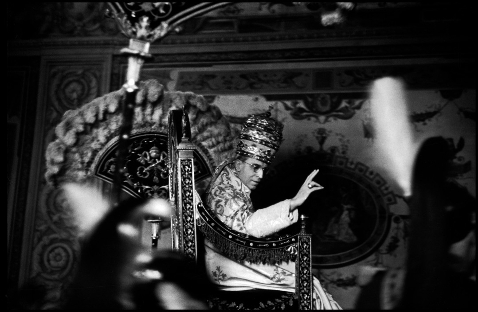
He is carried across Vatican Square on the Sedia gestatoria, a portable throne carried by twelve footmen.

“If the faithful strive to live in a spirit of lively faith, they will not only pay due honor and reverence “to the more exalted members” (thus the justification of the use of such titles as “Monsignor”; “Excellency”, “Eminence” and “Holiness” when addressing the various ranks of hierarchy.) of this Mystical Body, especially those who according to Christ’s mandate will have to render an account of our souls, (Thus justifying the power of censure, ex-communication, and determining who is worthy of receiving the “Sacred Species” or “Holy Communion”, and in my opinion, misnamed as the “Eucharist”, a term that means “thanksgiving”. used as a tile for celebrating the Word of God in the Liturgy or work of the People of God.) but they will take to their hearts those members who are the object of our Savior’s special love: the weak, the wounded, and the sick who are in need of material or spiritual assistance; children whose innocence is so easily exposed to danger in these days; and finally the poor, of whom is recognized as the very person of Jesus Himself as a perfect model of love for the Church” 

(Two extremes are highlighted yet Pius ignores Jesus teaching: For those who exalt themselves will be humbled, and those who humble themselves will be exalted. Mt 23:12 It’s ironic that this line introduces Jesus’ condemnation of the haughty leaders of Judaism, the Pharisees, and Sadducees as hypocrites.)

“Finally, the encyclical is principally remembered for its statement that the Mystical Body is identical with the Roman Catholic Church, repeated by Pius XII in Humani Generis (1950) in response to dissension. According to Mystici Corporis, to be truly a member of the Mystical Body one must be a member of the Roman Catholic Church. Other Christians who erred in good faith could be unsuspectingly united to the Mystical Body by an unconscious desire and longing (inscio quodam desiderio ac voto). In 1947, Pius XII wrote the encyclical Mediator Dei which acknowledged that baptized Christians were members of the Mystical Body and participated in Christ’s priestly office.” 

“During the Second Vatican Council, Yves Congar argued that the term ecclesia (‘church’) concerned the people “called forth”, the People of God, those over whom God reigns. “Body of Christ” then would emphasize the special union with the risen Christ that came with the new covenant. Congar was later denounced by the Holy Office for describing the Church as essentially a community in the Spirit, a gathering of the faithful and NOT the holy Roman Catholic Church.”

“The Second Vatican Council would later define in Lumen Gentium that the Church subsists in the Catholic Church. Avery Dulles argues this to be “an expression deliberately chosen to allow for the ecclesial reality of other Christian communities”, implying that non-Catholic Christians are members of the Body of Christ, and thus of the Church.”

While the Holy Office or the Vatican wanted to hold onto its power, fame, and fortune, for me the guidance and discernment lie within my CONSCIENCE  informed by the Word of God or Sacred Scriptures. And while the Holy Office interprets “the Body of Christ” as a two-part entity with the head being more important than the rest of the body parts, I prefer to maintain Paul’s analogy of equal parts and Jesus’ exhortation that “the exalted shall be humbled”!

THE MYSTERY OF THE CHURCH

Portions in quotes are adapted from the Text which is available under the Creative Commons Attribution-ShareAlike License;

To be continued

Posted in Church History, Ecclesiology | Leave a comment

KEEPING PARADISE: ACTIVE, PRACTICAL, SPIRITUALITY

Spirituality and the Spiritually Mature Person

 If the faith of a child does not develop into the faith of an adult, it can result in a view of religion that is childish, outmoded, and of no influence in adult life.  We see this today in people who bring to their individual lives, work, businesses, professions, and politics, a faith they learned as a child.  In every sense, it’s a mismatch.                                                                                          Bernard Lonergan, S. J


~~~~~~~~~~~~~~~~~~~~~~~~~

SPIRITUALITY TODAY

Spirituality is our personal experience of God in our every life.  It is living everyday 
in an ever growing consciousness of the presence of Sacred Oneness-in-Love throughout the world.
   Spirituality differs from our dogmatic maturity as we deepen our belief in the teachings of the Church, and from our moral maturity as we obey the moral laws of the church.


    To begin, it is important to understand God  not as a Being, but as BEING ITSELF, not just as existing, but as EXISTENCE ITSELF.  Every being in the universe, every atom, element, galaxy, planet, plant, animal, person, is a creation of EXISTENCE ITSELF.  In sum, we exist because EXISTENCE exists.  
    God is everywhere in the universe because Existence is everywhere in the universe.  If Existence was missing from a person or thing, the person or thing would not exist.  The universe therefore, can be said to be “saturated” with God.  Teilhard de Chardin said, we live in a “divine milieu.”

   Finally and of greatest importance, God is INFINITE  OVERFLOWING LOVE.  The universe, the world, and we are filled, with l love.  All without exception are the beloved of God.  Spirituality sees everyone as brothers and sisters, arising from one universal, overflowing Love.  

OVERFLOWING LOVE is Threefold:  it is CREATIVE, (Father) HEALING AND REDEEMING, (Son/Christ), WORLD TRANSFORMING AND EVOLVING  (Holy Spirit.

   With our spiritual consciousness, we see that the universe is made of love.  The earth is made of love.  The world and everything in it is made of love.  Every one is made of love.      Everything is made of love.  God hates only that which contradicts love.


                                     ACTIVE, PRACTICAL SPIRITUALITY  
   Spirituality is active and practical.  It is the way we live our daily lives, as we work to fulfill Jesus’ prayer, “Thy kingdom come…on earth.”  Spirituality moves and guides us toward creating a world of ever greater wholeness in love.
The secular world is God’s created world of space/time.  Contrary to popular belief it is sacred.  Everything and everything is sacred.  The opposite of secular is not sacred, it is profane, i.e., an abuse of the sacred.  By our egotism, greed, wars, etc., we make our abuse our sacred world and make it profane.

Our Vocation  
   We are called and empowered to lovingly build up up this world, i.e., ourselves, families, communities, education, politics, economics, sciences, arts, etc., aiming to make them ever more loving, just, peaceful, joyful, etc., in sum, making them more luminously human in the grace of Christ.  (Cf. the page,”The Spiritual Disciplines” in this blog.)  This call and empowerment is our vocation.
The Kingdom of God on earth will never be fully achieved.  The weeds will always grow alongside the wheat.  Our focus is to “grow the wheat” as well as we can, and leave the results to God.

EVERYDAY MYSTICS AND PROPHETSSpirituality calls and empowers us to be: 

         a. Everyday Mystics
A mystic is a person of faith who can see what is hidden from atheists and agnostics,  We can discern God’s presence and intentions within ourselves, and within today’s society and culture, i.e., we can spiritually “read signs of the times” and discern how God’s wants us to work to build God’s Kingdom on Earth in and for today’s society and culture.

   Our individual discernment of God’s presence and intentions determines our personal   vocation.  We also discern our vocations in terms of our age, gender, race, national origin, culture, personality, history, talents, opportunities, etc.  All of these are parts of our call from God.

    We discern our individual vocations within the one Catholic Faith.  We must be wary of people who claim to have private, exclusive vocations that call them to act in an improper or dangerous way.


          b.  EverydayProphets:
                A prophet is someone who proclaimsand applieswhat he/she discerns.  
                As everyday prophets, we humbly, peacefully and lovingly work to elevateourselves and our society and culture, in order to make ourselves and our culture more luminously human and loving in the grace of Christ.

c.  Sharers in Christ’s royal office,
                 We also are called and empowered to humbly, peacefully and lovingly work to correct and heal ourselves, our society and culture in Christ’s self-giving, healing and saving grace.

    Since we can easily mistake our own cultural or personal preferences for God’s intentions, we cannot walk our spiritual journey alone. We walk together with all the other members of our faith, and with all people of good will.  

   Besides growing spiritually by following the Spiritual Disciplines, we mature even more by following the Beatitudes, i.e., Blessed are the poor in spirit, those who mourn, the meek, who hunger and thirst for righteousness, he merciful, the pure of heart, the peacemakers, the persecuted for the sake of righteousness. (Mt. 5:3-10.)  

THE SPIRITUALLY MATURE PERSON                                         

We are spiritually mature in community
Here we have to be very conscious of our cultural preference for individuality.  Yes, we are individual, even unique persons.  But we are individual, unique persons within the human community.  We cannot separate ourselves from the community–family, local, national, world, nature–without contradicting our very humanity.  

    It is impossible to understand a person who is not deeply related to all other people, and to animals, plants, the soil, sky, climate, etc.

     While it is possible to walk our spiritual way alone, it is better to walk our way with a companion or companions.    

God calls us to our fulfillment not from the past from from the future into the future.  We don’t forget the past but build on it as we work to transcend our present self–no matter how old we are–and work to evolve into an ever new self of deeper meaning, justice, peace, joy of life, and overall wholeness in love.   

    
Spiritually mature persons see beyond themselves and see and live within the big picture, the whole picture.  They see with a lively consciousness of the whole, which is love.  They take an active, respectful part in the local community, national community, world community, ecological community, and universal community.  (Think of narrow minded politicians who put their jobs, or their party, over the good of the community they represent.)  

 Spiritually mature persons fulfill themselves and their own individual fullness and integrity by reaching beyond their own limitations and views and considering the views and needs of others.  They work to fit everyone and everything into the picture in justice, peace and love, respecting each individual within the universal picture, and paying special attention to the poor, sick, vulnerable and outcast.  

Spiritually mature persons know that the ultimate source and goal of unity and wholeness in love is God, who is present and active within the entire evolving community of the world, calling the world forward from the future.  

    The spiritual mature person is not naive.  We will never achieve heaven on earth.  the wheat and the weeds will grow side by side until the end of our space/time existence.

                 Spiritually Mature Persons Live with a Spirit of Detachment
   Spiritually mature persons live in deep, active engagement with others and nature,along with the ability to let go when necessary. 
Jesus told the rich young man to sell all his goods and give the money to the poor (Mt. 19) because he saw that the young man was attached to his wealth.  He was identifying himself by his wealth.  If he asked himself, “Who am I?” he would respond, “I am a rich young man.”  Jesus wanted him to detach himself from such a false and harmful self-identification and find his true self, which he could find only by letting go of his attachment and identifying himself as a child and image of God, and following Jesus–thus finding his true self.  

   It is morally acceptable–and necessary–to have money as long as we are not attached to it and to the things it can brings.

 Spiritually mature persons also work to help people detach themselves from harmful, disintegrating communities, e.g., racist or sexist communities, destructive political communities, militant communities, communities of the rich against the poor, etc.

Spiritually Mature Persons Accept the Inevitable      Suffering
    We Christians are not masochists.  We do not seek suffering and death, but seek relief, solace or medical treatment when we need them.      

     Spiritually mature persons accept life’s inevitable losses, setbacks, sickness, growing old, and death.  They let unavoidable pain be pain, and they evolve and mature spiritually–not despite the pain and suffering that come into every life, but in and through their inevitable pain and suffering.  Thus they are able to gain strength and new life from their suffering, just as Jesus gave us new life through his suffering and death.  

Spiritually Mature Persons Use Their Imagination  
  Spiritual transformation and advancement begins with imagination.  Spiritually mature persons imagine new ways to transcend their present selves and find new ways to help our world evolve into new levels of love as we help move the world toward wholeness in love. 

Imagination leads to intention.

Spiritually Mature Persons Activate Their Power of IntentionIntention may be described as a purposeful plan to perform an action, which will lead to a desired outcome. (Author, Lynn McTaggart)  Intention strengthens our coherence with one another. Intention must come from our deepest self, where we are one in love with everyone and everything.  Intention is the fruit of contemplation and does not come merely from the ego.  Intention leads to commitment and to action. 

Spiritually Mature Persons are Persons of Commitment and Action
    Spiritually mature persons are “everyday prophets,” i. e., they act on what God leads them to discern, and then they knowledgeably, peacefully and lovingly work to elevate our society and culture.  Where necessary, they also knowledgeably, peacefully, humbly and lovingly act to correct our society and culture, to make us all more luminously human and loving in the creative, healing and world-transforming love and grace of Christ.

  They actively live the Spiritual Disciplines.  (See the “Spiritual Disciplines” page on this blog.)

Spiritually Mature Persons are Persons of Prayer, Mediation and Contemplation 
    Prayer, Meditation and Contemplation are discussed on their own page of this blog.

by Anthony T. Massimini, Ph.D. Comments:  amassimini@verizon.net

Posted in Spirituality | Leave a comment

The Journey from Paradise Lost to Paradise Found Part 2

We begin OUR JOURNEY to PARADISE FOUND by setting the background for the Exodus Story which begins with the narrative of the family of Jacob and Rachel who had twelve sons. The first ten were maidservants of Rachel and her sister Leah but the last two were from Rachel, the first being Joseph who then became the favorite of Jacob as the firstborn of his wife. Eventually, the brothers become jealous of Joseph and decide to eliminate him by casting him into a cistern to die. They feel guilty, so they sell him to travelers who were going to Egypt where Joseph eventually rises from a slave to become a high official in the court of the pharaoh. 

The story continues. A terrible famine occurred in the land. Because Joseph rose to power, the Israelites or tribes of Israel headed by his brother, Juda, decide to turn to him out of desperation. Joseph arranges for them to come to Egypt to relieve their hunger. Once there, the ascension of a new pharaoh “who did not know Joseph” (Exodus 1:8) is the beginning of their bondage or captivity by that powerful pharaoh who becomes concerned by the number and strength of Israelites in Egypt and enslaves them. The people of Israel are now in bondage and are held captive by an overpowering, formidable enemy. Lesson: Loyalty to man is precarious, Loyalty to God is a surety

Now, let’s pull apart this part of the story. The favoritism of Jacob toward Joseph leads to the jealousy of the brothers which led to unbridled anger which led to a desire to kill or eliminate the source of the brother’s jealousy. Jealousy or envy is one of the 7 deadly sins that the Catholic Church calls the Capital or “head” sins. They are Pride, Envy, Lust, Anger Gluttony, Greed and Sloth.These are the attitudes that lead to all other sins. Remember sin is really more than an action that is considered bad- it’s an action that separates us from the ground of all GOOD that we call God. Lesson: Our favoritism has consequences of some sort

From a personal standpoint then, this story of Israel’s bondage is our story. How often do we find ourselves reacting to trouble, disappointment, or shame by becoming jealous or by putting the blame on someone else causing ourselves and the other person to enter into a toxic relationship which begins to overpower us, a condition from which we find it hard to escape? Or how many times do we use other behaviors like greed, lust, or anger, to escape our troubles and wind up as slaves to one of many addictions that plague our lives and our society?

Alcoholism, drug addiction, pornography, consumerism, materialism, and many other such habits of escape lead us into captivity that becomes a bondage of sorts. And the worst part is that others make money off of these problems and that, my friends, is the horror of our times.

SO, the Exodus Story is not just about the Israelites escaping bondage or slavery but about our lives as well. “It’s about bondage, liberation, a journey, and a destination,” says Marcus Borg in the book mentioned above. Eventually, the Israelites desire to find a way out of their captivity. But they will be leaving a familiar home, with security and food, and familiar surroundings. Isn’t it just as hard for us to quit an addiction? To stop drinking or stop feeding our sexual desires, or our proclivity to “shop till we drop”? While we know the pain and suffering of our captive addictions, leaving them behind is somehow more frightening. It seems that we say to ourselves that only a miracle will save us! Reflection: What have we become slaves to?

Ah, so now we go to the Story of the Exile and Return.

As much as liberation from the bondage of Pharaoh or the bondage of an addiction might be desired and necessary for survival, the fear of uncharted territory or even a wilderness of thorny unfamiliarity or new friends and new behavior frightens us. How long will it take before we are “home” or back to normal or will we ever get back to normal?

Recovery from bondage or addiction can take a while even a lifetime according to AA participants. For the Israelites it took forty years! Forty years in the wilderness, in the desert, without anything but manna or slim pickings. Leaving our addictions might cause us to leave home, family job, and even friends if they are deemed to be toxic and contribute to our addiction. The uncertainty of the future can be disconcerting even paralyzing causing us to wander and even want to go back to our addiction, back to the land of our captivity. “And the people of Israel said to them, “Would that we had died by the hand of the LORD in the land of Egypt when we sat by the meat pots and ate bread to the full, for you have brought us out into this wilderness to kill this whole assembly with hunger.” Exodus 16:3

Once back in their land and after forty years, they begin live in somewhat normal times. Their monarchy is established and Jerusalem becomes the capital of King David’s kingdom and then then the First Temple is built in Jerusalem by Solomon. Eventually the kingdom is divided in two: Israel and Juda with the later being attacked by the Assyrians and then being conquered by the Babylonians resulting in another exile once the Temple is destroyed.

As in the case of the nation of Israel, Liberation from an addiction can be scary, daunting, even too much to handle without discipline and it can even become a catalyst for recidivism or “falling off the wagon” as many a recovering alcoholic or addict will admit. The behavior of both David and Solomon were far from keeping the Commandments of their God and lead the Israelites on to the road o perdition. Once in disarray and caught off guard because of the lack of discipline, bad things can happen and did as described above.

Now don’t think that all this just applies to Israel or those who are addicts in the usual sense of the word or condition. No, it applies to all of us, the People of God, who like Adam and Eve, David and Solomon, leave Paradise every time we sin or separate ourselves from the Will of God. (The word disciple, is related to discipline: following certain knowledge.) We become misguided by a “Satan” or “snake” of our own making and wind up in the exile of separation and even depression. They say, “The best intentions pave the way to Hell.” and without discipline and a plan we perish. This is happening to our Church and to our country and to millions of Americans who are falling prey to lying, conspiracies, and even racism and bigotry. In both cases, the Church and America, the loss of power, the power of the clergy and of the white people is causing a deterioration into jealousy and anger, as well as shame and depression which is the perfect recipe for exile. The story of Israel is our story as well.

Therefore, the consternation and conflict we experience these days in America and around the world indicate the need for a return to discipline and principles or in both cases mentioned above, a return to virtue, truth, and the values that contribute to justice and freedom for all. if we are to live in a world of peace and tranquility we must recall to source and roots of our beginnings. For America, it’s the Constitution and for the Church it’s Jesus. A radical (going to the roots) movement is therefore necessary. The Israelites were reminded by the prophets about when Moses came down from the Sinai mountain with the ten commandments:   “In the third month after the Israelites’ departure from the land of Egypt, on the first day, they came to the wilderness of Sinai.”Moses went up to the mountain of God. Then the LORD called to him from the mountain, saying: This is what you will say to the house of Jacob; tell the Israelites: You have seen how I treated the Egyptians and how I bore you up on eagles’ wings and brought you to myself. Now, if you obey me completely and keep my covenant, you will be my treasured possession among all peoples, though all the earth is mine.You will be to me a kingdom of priests, a holy nation. That is what you must tell the Israelites. Gen 19:1-4

Thus begins the Priestly Story.

In this story, the Israelites receive directions, laws, rituals to assist them in becoming right with God. Sin, guilt, sacrifice, and forgiveness become the keys to unlock another bondage that kept them from the Promised Land or Paradise. For us the bondage can be ourselves, the tendency to want to be God by submitting to the lures of power, fame, and fortune. These three entities enable humans to control those who are still in the wilderness of exile or worse yet in the bondage of oppression and slavery which in the modern world is poverty. We must remember that the Israelites were led into Pharaoh’s grip of oppression because of a famine and a family rivalry. Famines are not just about food. They are about the lack of preparation, concern, caused by greed, neglect, and even worshiping idols to obtain favors and wealth in order to obtain power, fame, and fortune which some believe are essential to freedom and autonomy. The situation of the Israelites was so bad due to their proclivity to ignore God’s commands, that prophets arose to speak on God’s behalf and Teachers of the law devised 613 mitzvahs or mini-laws to help their people keep those ten commandments. The bondage of the Pharaoh was now replaced by the bondage of sin, guilt, sacrifice, and the constant need for forgiveness. Does this sound familiar? The Catholic Church has made these the foundation and structure of the Church to increase the ability and discipline to follow God’s Law more than following the Word or Jesus.

Needless to say, this is a burden that most people are no longer willing to bear. Rather, they seem to prefer the exile and wilderness of materialism, consumerism, technology, and entertainment which are replacing the need for God’s grace and presence. Those activities are society’s new religion- the “altar of Wall street “ which is far more profitable than religion in the here and now. People want Paradise now while they are alive.

Thus the authentic Paradise is still lost. This is not new because the biblical story describes how the Israelites were then overtaken or captured several times by foreign powers like the Persians, and Babylonians, and Romans. Their prophets warned them that this would happen but they ignored the warnings, much like when others warn us that we are about to return to bondage or exile and we ignore them.

Rome took over their land and ruled for many years thereafter. It was then that Jesus of Nazareth began his ministry, his activity, and teaching.  No doubt he was shaped by the stories of the exodus, exile, and priestly structure of responsibilities that resulted in the initiation of two groups: the Pharisees who claimed Mosaic authority for their interpretation of Jewish Laws, and the Sadducees represented the authority of the priestly privileges and prerogatives.

Jesus began by challenging the system of Jewish laws and privileges of the Sadducees which became a burden upon the ordinary people whose life history was one of bondage and oppression by the Egyptians, Babylonians,  and now the Romans.

The same has happened with Catholicism. Canon Law, tradition, and dogma are seen as burdens for many who are trying to follow Jesus. The only hope the people of Israel had was the savior or Messiah that the prophets had promised. Their liberation was long overdue but tempered by the regulations and practices of their religion which overcame the people with hopelessness. Isn’t this our story as well? Who is our savior?

The message of Jesus was the one expected by John the Baptist, a message of forgiveness rather than the slavery to the law. He laid the foundation for a messiah that would free the people from the current bondage of the Romans and of the Jewish laws and bring about the promised Kingdom of God which you and I might refer to as Paradise found! “Then Jesus said to them, “The Sabbath was made to meet the needs of people, and not people to meet the requirements of the Sabbath.” Mk 2:27

Jesus teaches the Way to freedom, the Way to the Kingdom of God or Paradise where “God would bring down the powerful from their thrones, and lift up the lowly, and fill the hungry with good things, and send the rich away empty.” to paraphrase the Magnificat of Mary. Lk 1

His stories, parables, and teachings were validated by his healing, his freedom to eat with outcasts, and his ability to challenge the leaders of his own religion who added to the burdens already heaped upon them by the Romans. He appealed to fishermen, laborers, women, who were treated like property under the laws of Judaism, and even to a few who were members of the elite groups of religious leaders and at least one member of the Roman army- the centurion.

Given the weariness of their history of oppression and bondage and ours as well, his words were and are enticing and welcomed: “Come to me, all you who are weary and burdened, and I will give you rest. Take my yoke upon you and learn from me, for I am gentle and humble of heart; and you will find rest. For my yoke is easy, and my burden is light.” Mt 11:28–30

Finally, the people had found a way to Paradise in Jesus, and a way to eternity in God’s presence, the Promised Land that all of us desire and hope for.

Thus Christians can live and walk in freedom from the bondage of the worldly life with the very Word of God made human in Jesus who declared, “I am the Way, the Truth, and the Life”. Jn 4:6

Paradise is found in Jesus and we can participate in it if we open ourselves to the power of the Spirit that we were promised by Jesus:

“If you love me, keep my commands.  And I will ask the Father, and he will give you another advocate to help you and be with you forever—  the Spirit of truth. The world cannot accept him, because it neither sees him nor knows him. But you know him, for he lives with you and will be[in you. I will not leave you as orphans; I will come to you. Before long, the world will not see me anymore, but you will see me. Because I live, you also will live.  On that day you will realize that I am in my Father, and you are in me, and I am in you. Whoever has my commands and keeps them is the one who loves me. The one who loves me will be loved by my Father, and I too will love them and show myself to them.” Jn 14:15-31

Posted in Scripture | Tagged , | Leave a comment

The Journey from Paradise Lost to Paradise Found

Part 1 Paradise is not out of our reach! It’s not saved for later!

When most of us think about paradise we conjure up ideas about a place that exceeds all our expectations, a good spot to live! In the Judeo-Christian tradition paradise is the world as God created it, perfect! “God looked at everything he had made, and found it very good.” Gen 1:31 Then things went bad. Adam and Eve messed up. They thought they knew better than God and ate the fruit. The author of the story knew mankind well enough to figure that they would blame somebody and in this case it was the devil, Satan, posing as a snake. I think of  Flip Wilson’s character, Geraldine, who always said, “The devil made me do it!”

Regardless of who was to blame, the fact is Adam and Eve lost paradise and the rest of us have been suffering ever since. “Cursed is the ground because of you! In toil you shall eat its yield all the days of your life. Gen 2:18 But isn’t that a story?

As children, stories got our attention because they filled us with images and ideas to which we could relate, entertain ourselves, and even be comforted. Cinderella and the Jealous Bullies, the Three Bears and the Careless Intruder, Hansel, Gretel and the Untrustworthy Adults, The Frog Prince and the Pitiless Princess all taught us something about life and how to cope with it. 

The author of Genesis must have known we could relate to the story he wrote. He wanted to explain to his fellow inhabitants why they found themselves in a hell of a predicament since they were complaining about the hardships of living and how it was not their fault.  After all, they worked hard yet nothing seemed to get better. People cheated, stole, and even killed their own brother to get ahead. Thus the author included the story of Cain and Abel.

Despite hearing the story so many times from childhood and on, it  seems to have lost its real significance and most of us have become fatalistic about the condition of humanity today and just shrug our shoulders and say, “That’s the way it is. Life sucks”!

What’s the use of imagining a paradise, although God knows we try to make one! Resorts are advertised as “paradise” on earth! Even our homes and cars are likened to the perfect place to remedy our ills. Consider how much effort and money most of us spend to try to create a paradise for ourselves. 

Is anyone ever satisfied? Is paradise just for some of us? Many can’t begin to realize that dream come true! As a result crime increases, murders are numerous and even violence between different groups is constantly escalating. All we can do to alay our fears and sorrows is to pray and suffer like Jesus did according to most preachers. Our reward will be the heavenly paradise! What we are left to do is to imagine what the heavenly paradise will be like and look forward to it, at least for most of us without millions to make our own.

John Lennon’s song, Imagine says it all.

Imagine there’s no countries

It isn’t hard to do

Nothing to kill or die for

And no religion, too

Imagine all the people

Livin’ life in peace

Imagine no possessions

I wonder if you can No need for greed or hunger A brotherhood of man

Imagine all the people Sharing all the world

You may say I’m a dreamer But I’m not the only one

Imagination is a human characteristic that only humans possess. A little child will often ask “why” something is happening, “what” something is, or what can be done when something bad happens. Stories help a child to grasp the meaning of the world around them by attempting to relate the information in a concrete tangible manner with visuals and sounds that are familiar to them. Thus drawings, words, objects, and music are some of the most primary tools by which we learn. We create a pretend world in which we can live, a world that gives meaning and satisfaction to what’s going on within and around us. Religion does that for us as well. We’re promised that there is a “heaven” or as I like to say, a “haven” where nothing will go wrong and all will be well.

As we get older, reality hits us like a slap in the face and we wake up from fantasy land only to confront the real world of pain and sorrow, work, success or failure and so many more ups and downs of life. We try to figure out the purpose of our existence and usually conclude that we can only survive and feel safe and secure from whatever causes us pain, sorrow, or disappointment. However some say,  “Eat or be eaten” as Elton John sings in the Circle of Life song. 

“Those who work their land will have abundant food, but those who chase fantasies have no sense.” Prov 12-11

In the Judeo-Christian heritage, the Bible is the source of many stories that attempt to feed our imaginations and alay our fears and anxiety by attempting to describe the perfect origins of life on our planet and the universe in which it is located and the significance of our little life amidst it all. The scriptures try to explain the various behaviors of humans both good and bad, like Cain and Abel, David and Bathsheba, Joseph and the Pharaoh and of battles won and battles lost, heroes and heroines, oppression and freedom, life and death and everything in between.

Reality for adults came when science raised its rational and factual head, bursting some of the most endearing myths that made humans comfortable and safe, like waiting for heaven above, like the Sun revolving around planet earth, or that the earth was flat and heaven was in the clouds. In almost every area of life, science changed how we view life and our own lives. For many people, the numerous sciences like astronomy, physics, biology, psychology replaced the many biblical stories and tales found in the Bible that tried to explain our world and human behavior. 

It has been said that one’s Faith nourishes one’s Reason and one’s Reason nourishes One’s Faith.

In reality some of those stories were and are seen as actual events which are parts of history that bear little more than factual information to remember or forget. Yet for many others those stories were explanations for the good and bad in the world and how we might survive similar calamities and hope for a positive outcome or be rescued by the Divinity we worship.

As humans journeyed through the ages, legends, fables, myths and other narratives were used to teach the common people about their culture, ethnicity, religion, society and even themselves. Eventually even fairy tales were used to explain the unexplainable or the mysterious parts of life, such as desires and dreams. The stories would encourage people to have hope and faith or help them cope with tragedy and devastation caused by disease. 

During the Enlightenment many  facts, discoveries, and other scientific information threatened the existence of such stories. A divide began to occur between faith and reason and eventually anything associated with religion and its stories became known as superstitions or myths that were debunked.  Many used such excuses for abandoning religion and anything associated with it. Yet most believers saw science as the enemy of their religion and the faith. Infamous scientists like Galileo and Newton, Kant, and others were chastised and in some cases declared heretics to be shunned and put on trial. Their works, books and theories were banned by the authorities for a long time after their death.

Use of Reason. Natural Laws. Study of everything. The world. Weather. Flora and Fauna. Geology. Astronomy. Social Sciences. Exploration. New Philosophers. Kant. I think therefore I am

Today, religious stories and legends are still popular, however most of them don’t provide the same kind of inspiration, awe, and wonder that they provided for our ancestors even as late as the twentieth century.  Politics, entertainment, sports, commercialism, journalism, media, and the internet are now the means by which we seek solace, affirmation, acceptance, and even love and contentment. That which confronts us: tragedy, disease, addictions, divorce, senseless killings, mental illness, racism, bigotry, poverty, and homelessness appear to be incurable or unsolvable. Medicines, therapy, advice, “how to” books, videos, or podcasts and social media seem to provide temporary fixes for the individual but not for humanity in general. The state of human affairs seems horrifying to say the least. Is faith lost? Is Paradise still attainable?

Still, as Carl Jung concluded, “There is a religious instinct in all human beings – an inherent striving towards a relationship with someone or something that transcends human power (a higher force or being). Deep down most of us want to believe what is proclaimed about heaven and our future in that “paradise”. However,the Paradise that we long for appears to be unreachable, maybe even lost. The biblical story certainly conveyed that but human progress and ingenuity seems to contradict that command not to eat from the Tree of the Knowledge of Good and Evil because we have concluded that we can determine such. Of course today we ask WHAT is TRUTH? Our world appears to be crumbling and paradise seems to be more elusive than ever! But there’s hope.

Marcus Borg, an eminent scripture scholar and author of Meeting Jesus Again for the First Time, offers another interpretation of the events, people, and traditions found in the Bible. He claims that they are theological stories that attempt to use narratives as a means of understanding and gathering significant meaning for the people of Israel which are even relevant for Christians and Jews today. He goes on to demonstrate how story and storytelling provides not facts but a wealth of symbol, ritual, and tradition that can help us cope with everyday life just as the ancient peoples did.  “There’s nothing new under the sun” we are told. If they found in those stories what comforted them, then we should too. Such stories were the means of educating and indoctrinating or catechizing the people of Israel and later they did the same in the Christian era even including this modern world.

Borg also stated that his central claim about the value of stories in the bible is captured in three “macro-stories:the Exodus Story, the Story of the Exile and Return, and the Priestly Story. These, he insists, are at the  heart of Scripture” because they shape the Bible as a whole and provide a description of a spiritual and religious life that ultimately leads to a  life of happiness, well-being, and even  to a paradise of sorts, not a dream or fantasy but to a healthy, content, life that shares itself in love by caring, serving, and respecting everyone on the planet by sharing and making sure all live in peace and harmony. A tall order but possible! “The Christian ideal has not been tried and found wanting. It has been found difficult; and left untried.” G.K. Chesterton

Part 2 will explore how these three major stories help us find the Promised Land, the Paradise that each of us lost. Stay tuned!

Posted in Scripture | Leave a comment

Nurturing Our Soul While Training Our Mind and Body

The Spiritual Disciplines compiled by Tony Massimini, PhD

St. Paul compared spiritual development to a race toward a goal (Phi 3:14).  Runner must train to develop and strengthen their energy for a successful run.  The spiritual disciplines (also called dynamics) are the various ways we develop the energy that God gives us to reach our goal of spiritual maturity.   Here is a list of disciplines for us to meditate on and apply to our daily lives in Christ.

1.  Love, Compassion, Charity and Mercy God is love, and so love is the heart and soul of all the spiritual disciplines and of our entire life.  Our Christ-ed life on earth is our ever evolving journey toward wholeness-in-love, toward ourselves, others, nature, the whole world and universe.  


    Love embraces our total self; it includes our thoughts, our emotions and our deep, active, willing commitment to help others in every possible way, for their own sake.  Love moves us to work for the highest good and happiness of others.   Compassion moves us to love so that we feel strongly the needs and pain of others and help them in their needs and pain.
Charity moves us to love even at a cost to ourselves
       Here we can include Mercy, which is our imitation of God’s loving benevolence, forgiveness and compassion.  Spiritual works of mercy include aiding our neighbor in spiritual and bodily necessities, instructing, consoling, comforting, forgiving, and bearing wrongs patiently.  Corporal works of mercy include feeding the hungry, sheltering the homeless, clothing the naked, visiting the sick and imprisoned, and burying the dead.

2.  Order:  Like creation itself, our movement toward wholeness-in-love engages us in an ever-evolving, age-appropriate movement from chaos to cosmos, from disorder to order.  (Order for a 2 year old is not the same as order for an adult.)
      We nourish and elevate ourselves and our society and culture when we accept our spiritual responsibility to organize and harmonize ourselves, our families and communities, our education, our work, politics, economics, science, art, etc., so that we and our society function efficiently and effectively, avoiding wasteful disorder on one hand, and obsessive strictness on the other hand.


3.  Justice: “To each his/her own.”  We all have a God-given right to life, freedom, food, shelter, safety, education, employment, health care–in general, the pursuit of happiness.Here we also include the Beatitude by which we hunger and thirst for righteousness (Mt. 5:6), namely, living in conformity with God’s will.  Also, setting the standard high and living up to it.Order includes Social Justice, working for the common good, with a preferential option for the poor, sick, vulnerable and outcast.   Anger is a normal, healthy emotion in the face of injustice (CCC 2302-2). Jesus told us not to be angry (Mt. 21-2) because in his culture, anger carried with it the intention to murder the person you were angry at.  Justified anger must always be used to correct and heal injustice, never to destroy.  St. Thomas Aquinas said that we should always keep humility one step out in front of our anger.


4.  Respect:  Closely related to Justice, it means, “taking a second look, (Latin: re: again, specto: look)  Our first look at someone can mean, “What’s in this for me?”  Our second look can then mean, “What can I do for the other?”      Fear of the Lord is related to respect.  It can mean a childish relationship with God with fear of offending a parent for fear of punishment.  This then matures into a respect for God, so that we would not even think of offending God.
    A spirituality that emphasizes sin, repentance and hell, to the near exclusion of the Easter and Pentecost blessings of renewed life and spiritual progress, joy and hope, tends to keep people God-fearing and spiritually immature.  Spiritual development moves us from asking, “It is a sin to do this?” and saying, “See how we fall short,” to asking, “How can we best love God in doing this?” and “Here’s how to apply our faith in this matter or situation.”  In this way, we go from making decisions between good and evil to making decisions between good and better.   


5.  Peace:  Peace follows upon order, justice and respect.  It is not merely the absence of conflict but the positive reaching out to help one another become who we truly are, who God intends us to be and become (CCC 2304)    Blessed are the peace-makers, i.e., the reconcilers of disputes between individuals, groups, e.g, the right and the poor, religions, political views, ethnic groups, nations, etc.    We must work to overcome all threats to peace, e.g., injustice, economic or social inequalities, etc., (CCC 2317)

6. Thoughtful Silence and Solitude:  God speaks in a whisper (cf. 1 Kings 19:9-13).  In today’s noisy culture it is difficult to “hear” God.  In the mid-20th century, the ex-Catholic, agnostic philosopher, Martin Heidegger said that is God exists, he is known today by his absence.  How true is that in today’s culture?  
   We spend blessed, quite moments with God, e.g., in church, watching a sunset, on retreat, gazing at a sleeping child, etc.  


7.  Mourning:  The Beatitude (Mt. 5:4) teaches us to mourn for injustice–personal, in society, in our culture, in our church.  When we act prophetically to elevate our humanity and where necessary to correct and heal injustice in the love and grace of Christ, we can expect to suffer some pain.  We are blessed when we suffer for the sake of righteousness (Mt. 5:10-12).


8.  Humility:  This all-embracing discipline and spiritual dynamic arises from our deep sense of who we are, namely created and graced children of God, who owe everything to God, without whom we would not even exist. (CCC 2559).    Our Self-esteem and pride in our own accomplishments are valid only within the discipline of humility.  For example, “I accomplished this or that by my own, free effort and abilities, but only because God created me and gave me the talents and abilities to do this; and Jesus died for me and gave me the grace to live in him.”  In humility, we empty ourselves of all false pride.   

9.  Obedience:  The freedom to obey God and the truth in all things, to accept reality as it truly is.  The freedom not to always have to be, “Number One!”  It is related to respect, which we give first to God/truth/reality and then to the dignity and rights of others.  It is the will to obey all just laws, leaders and superiors, as long as we are convinced that they are expressing truth and reality, and therefore, the will of God.  Therefore, it is also our will to oppose all unjust laws, leaders and superiors when they are not expressing God/realty/truth.      Obedience opens us to be poor in spirit (Mt. 5:3) in the positive sense of this spiritual discipline.  In the negative sense, the poor of Jesus’ time were so oppressed by the rich that they were depressed and dispirited, i.e., poor in spirit.  Jesus felt compassion for them and blessed them in a special way.      In the positive sense, poverty of spirit means emptying ourselves of selfishness and greed so that we can see God and others in reality and truth, and thus obey, i.e., do what is necessary to help others become who God wants them to become, e.g., have a deep and active compassion for the financially poor.  It means taking up our cross and following Jesus in all things. (Mk. 8:34)


10.  Trust:  The sense of feeling safe in our interactions with God, others, family, community, school, work, and in all our society and culture.


11.  Faith:  (CCC 153-184)  Faith may be described as our loving, trusting, deep persuasion that God exists and that God is All Loving.  It is our “belongingness” with God.  Faith includes our reception of the truth that God has revealed to us.  The certitude of faith comes directly from God. (CCC 156-7).  


   Faith and reason do not conflict.  Faith is reasonable.  However, while we can logically reason to the existence of God, reason alone cannot give us unshakable persuasion and certitude that God exists.  People can also logically reason to atheism.  But atheism cannot prove that God does not exist.  As stated above, the certitude of faith comes from God.  (We can reasonable and logically explain our faith to an atheist, and we can help dispose an atheist to receive the faith by our explanations and the example of our lives, but the faith itself and its certitude can come to the atheist only from God. So we should never argue with an atheist.  Atheists are atheists because they don’t have what we have, namely, faith.)


   Science operates in a different context from faith.  Science is our best understanding of how the universe works.  It’s certitude rests upon observation and conclusions, and it can and does change, e.g., scientists once thought that the earth was at the center of the universe, that the atom was solid, etc.  Faith gives us the gift of appreciating the deepest and truest meaning of the universe.  There is no conflict between faith and science.  
   Science is not set up either to prove that God exists or that God does not exist.  Scientists who say they are atheists because of their science are making an unscientific, illogical, unreasonable and meaningless statement. 
   For example, some scientists, e.g., Richard Dawkins, often unknowingly use the philosophy of materialism or positivism as a structure for their science.  In short, these philosophies says that if something (or Someone) cannot be sensed, weighed or measured, it, He/She does not exist.  They only accept material evidence.  (Some of these scientists will say, “Well, without material evidence,I won’t say it doesn’t exist, but that it just is not important.”) Thus they “conclude” that God does not exist because they started with the premise that God, who is not material, and who cannot be sensed, weighed or measured, does not exist.  They simply “prove” what they already believe.


12.  Study:  The more knowledge and understanding we have–scientifically, poetically, politically, economically, etc., the more clearly, maturely and fully we can respond to God and the more successfully we can live.  
    Our faith also grows.  While it remains essentially the same, we are learning more and more about God and our relationship with God every day.13:  Wisdom:  Our knowledge and understanding are perfected by wisdom, which is the everyday, practical, common-sense way of living.  Wisdom is a gift of the Holy Spirit.


14.  Simplicity:  “Say yes when you mean yes, and no when you mean no.”  (Mt. 5:37).  Simplicity moves us to live in open, joyful, and direct truthfulness and honesty.  Duplicity leads us to “spin” our political and economic views, to exploit the poor for our own good, and to be hypocrites.  Simplicity moves us to be clean of heart (Mt. 5:8).  It fosters “spiritual poverty” by which we “travel light” through life, not accumulating unnecessary goods, prejudices, etc. Simplicity is related to healthy spontaneity, openness of spirit, kindness, goodness, modesty, mildness, purity and chastity.To be simple does not mean to be naive.


15.  Meekness: (Mt. 5:5)  Meekness does not mean letting people run all over us.  It means facing life and adversity with a calm sense of Godliness and self-respect.  St. Thomas Aquinas said that meekness is our reasonable use of anger.  Meekness moves us to maintain our dignity as persons and to require others to respect our dignity. Jesus gives us three non-violent examples of maintaining our dignity through meekness. (Mt. 5:39-42).
   a.  Turn the other cheek.  If someone strikes you on your right cheek, they will strike you with the back of their hand, i.e., in a way that insults and degrades you.  By turning the other cheek, you say in effect, “Don’t insult and degrade me, respect my dignity.”
  b.  Offer your cloak.  The Jews had a law that a creditor could take all of a debtor’s belongings except his cloak, which the debtor would need in the evening to keep warm.  If the debtor offered his cloak, the creditor would have to refuse to take it, thereby placing the debtor at an advantage and permitting him to maintain his dignity.
  c.  Going the extra mile.  A Roman soldier could force a Jew to carry his armor for one mile, and one mile only.  If the soldier forced the Jew to carry his armor for a greater distance, he would be punished.  By offering to carry the soldier’s armor for more than a mile, the Jew placed the soldier at a disadvantage and thereby maintained his own dignity.

In that day the wolf and the lamb will live together; the leopard will lie down with the baby goat. The calf and the yearling will be safe with the lion, and a little child will lead them all. Is 11:6

16.  Creativity:  Creativity is our ability to discern new insights and images out of the galaxies of graced possibilities that live within us, the world and the universe, and to express those possibilities in ways that give us new and joyful appreciation of what it means to be human.

17.  Hope:  Hope is not wishingfor good things, but confidence that we can achieve goals and move toward our fulfillment, based on real accomplishments and successes that we have already attained, and on real possibilities.  Hope is our graced confidence in God’s love, support, encouragement, and his will to save us, based on his revelation and on Jesus’ life, death, resurrection and his sending us his Spirit at Pentecost. (CCC 1817-18)

18.  Joy of Life:  Joy of life is the celebration of just being alive, of being a child of God, loved and sustained by God (CCC 301).  Joy includes the religious emotions of awe and wonder.  Joy differs from happiness, when happiness means the satisfaction of getting the things we want, e.g., the American pursuit of happiness.  Our true happiness is in God. (CCC 1723).

19.  Perseverance:  Arising from hope, it is our ability to face our challenges and press forward with courage in times and situations of adversity.  It goes with the disciplines of Patience, Fortitude and Temperance.


20.  Prudence:  Prudence enables us to avoid rashness and do the right thing at the right time. It is the first of the Cardinal Virtues, which include Justice, Fortitude and Patience


21.  Service to Others:  We all share the same humanity and all have the same human needs.  Christ died for everyone.  Service is of the essence of the Christian life.

22.  Respect for Labor:  Even though we “get bread to eat from the sweat of our face,” (Gen. 3:19)  our spirituality considers work to be our cooperation in the ongoing, evolving creation and salvation of the world in the grace of Christ.  By our personal work we contribute to the realization in history of the divine plan. (Vat. II, Church in the Modern World. 34ff)

23.  Fasting and Abstinence:  Used properly, this discipline helps us concentrate more clearly on God and pray more effectively. (CCC 1434, 38)

24.  Confession and Forgiveness:  It is natural to want to tell others our needs and even our shortcomings and faults in order to receive counsel and forgiveness.  We confess our sins to God who graciously forgives us and sets us on our way again renewed and re-energized. (CCC 1422-70)

25.  Guidance and Counsel:  We provide guidance and counsel in many ways, e.g., by listening, by being a good parent, teacher or friend.  We provide spiritual guidance to one another by walking together on our spiritual journey.  Qualified spiritual counselors provide professional spiritual counseling and guidance.
   Spiritual guidance and counsel is not the same as psychotherapy.  Psychotherapy “unties knots” in people’s psyches and fosters a healthy psychological life.  Spiritual  guidance and counsel helps people live life in abundance, in relationship with God, and in relationship with others and nature, within their relationship with God.

The gift often commands actions that could never be explained by human reason, even by reason with light of faith. The gift of Counsel is especially needed when there is need for an immediate judgment and no time for deliberation.

26.  Gratitude:  The spiritually mature are quick to express thanks to all those who help them, to God for giving them their life and gifts, and to Christ for saving us.  Gratitude leads to worship.

27.  Worship:  All the disciplines lead us ultimately to worship God.  Worship is our fullest, most joyful, awe and wonder-filled, and most thankful and loving response to God’s creative, healing and world-transforming love for us, with which God creates, loves and saves us.  It is our full and supreme response and return of ourselves, others and the whole world to God.
   

God is spirit, and those who worship him must worship in spirit and truth. Jn 4:24

Posted in Spirituality | Leave a comment