
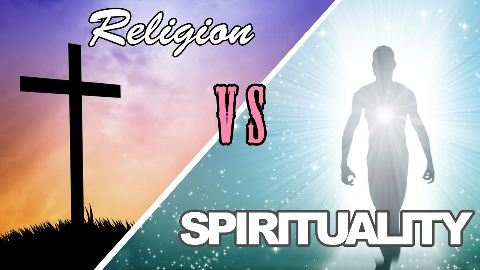
RELIGION
In the United States, religion is on the decline due to many factors. Part of the decline is because politics since the 1990s, has become part of the Catholic and Evangelical Churches’ mission to win support from the Republican political party which has adopted conservative Christian positions on many issues like same-sex marriage, abortion, and other issues in our society.
The Religious influence in politics has had the effect of causing other voters, especially young liberal ones, to move away from religion. The support of President Donald Trump by many evangelical leaders and by the Roman Catholic Church has hastened the exit of many of their younger and even older members.
Also, religion has lost adherents because of the scandals that have become noted in the various media outlets. Recent Pew Research surveys found that an overwhelming majority of US adults were disturbed by the leaders of both Protestant and Catholic leaders engaging in secret sexual affairs and the recent reports of sexual abuse by Catholic priests, seen as ongoing problems that are still continuing. Many US Catholics said that they have scaled back attendance at Mass in response to these reports.
Another reason for the decline in Catholic Mass attendance is due to the Covid virus which caused many Churches to celebrate liturgical events or services virtually through the use of the internet. This has increased a belief that the actual attendance of such services and events are not required to reap the spiritual benefits of worshipping in person.
“Gallup began measuring religious membership in 1937. In that poll, religious membership was at 73%. It remained above 70% for the next six decades. But the 21st century saw rapid change. In 1999, 70% of Americans said they belonged to a church, synagogue or mosque. By 2018, it was down to 50%. It continued dropping to 47% now with no indication that this trend will end.” The Monroe News, Hank Cetola, June 5, 2021
A Gallup report shows two trends in the decline of religious membership — falling rates among people who do have a religion and the rise of the “nones,” or people who do not identify with any religion. The data, aggregated into three-year subgroups, show declines in religious membership across all generations from 1998-2000 to 2018-20 (2008-10 for millennials). For traditionalists (born before 1946) the decline in religious membership was 7%. For baby boomers (born 1946-64) it was 13%, for Generation X (1965-80) 20%, and for millennials (1981-96) 31%.” The Monroe News, Hank Cetola, June 5, 2021
The religion of Roman Catholicism, as we know it, has existed since the empire of Rome made Christianity its official religion in the 4rh century. As the original denomination of Christianity, Catholicism has exceeded all expectations with 1.345 billion members despite its turbulent history of crusades, inquisitions, and wars. Catholicism is often labeled as patriarchal, authoritarian, misogynistic.
The justification for the three “labels” mentioned above can be found in the Code of Canon Law of the Catholic Church, Can. 129 §1. which states: “Those who have received sacred orders are qualified, according to the norm of the prescripts of the law, for the power of governance, which exists in the Church by divine institution and is also called the power of jurisdiction”. An all-male, celibate hierarchy or leadership is seen as a stumbling block to many members of the Church but especially to those under the age of fifty.
Catholocism was a nomenclature that originated in the second century of the common era. The word Catholic comes from the Greek adjective καθολικός, katholikos which means universal. The first use of “Catholic” was by the church father Ignatius of Antioch, an early Christian writer and Patriarch of Antioch in his Letter to the Smyrnaeans circa 110 AD).
The most basic foundation of the Magisterium, the apostolic succession of bishops and their authority as protectors of the faith, was one of the few points that were rarely debated by the Church Fathers. The doctrine was elaborated by Ignatius of Antioch and expounded by others such as Irenaeus, Tertullian, Cyprian, Ambrose, and Augustine, and by the end of the 2nd century AD was universally accepted by the bishops. One may note that all the above persons were male and referred to as “Fathers of the Church”
In the modern world of the 21st century, many Catholics have come to realize that an all-male organization, institution, or leadership reflects an injustice and inequality that is rejected by most of the Western world and is becoming an issue in many Eastern and Third World nations. With the exception of many Catholics over the age of 60, most Catholics today find this problematic in addition to the issues and criticisms cited above.
The Influence of the Roman Empire
The four popes after Peter were men who were of Roman, Greek, or Hellenized Jewish ethnicity. After those men, Popes were mostly Roman or Greek and maintained their independence from the Roman Empire until the end of the persecution of Christians through the Edict of Milan (313 AD) issued by Constantine the Great. Presided over the Lateran council of 313.
The state church of the Roman Empire refers to the church approved by the Roman emperors after Theodosius I issued the Edict of Thessalonica in 380, which recognized the catholic orthodoxy of Nicene Christians in the Great Church as the Roman Empire’s state religion. Then, the hierarchy of early Catholicism reflected, or ‘mimicked’, the organization of the Empire, with the ecclesiastical structure being headed by the emperor who appointed the bishops and organized councils for the purpose of settling disputes about certain theologies and beliefs. The Church adopted the structure of governing and the same organizational boundaries as the Empire: geographical provinces, called dioceses, corresponding to imperial governmental territorial division.
In the early Church, Popes were always selected by a council of Church fathers, often characterized by confirmation or nomination by secular European rulers or by their predecessors unit around 1059. We can conclude from this and history thereafter that the Catholic Church was and is patriarchal, and authoritarian, the latter being modeled after the emperors of the Roman Empire and other European nations as well.
According to many scholars, the Catholic religion as we know it is dying because modern social norms, technology and science have changed the world dramatically. They conclude that traditional religions no longer meet the spiritual needs of many people. Humans desire to have a purpose and meaning for living. A healthy spirituality nurtures the mind, heart, and soul and creates a life that is full of wonder, awe, and passion. Every aspect of life can touch the sacred and satiate a hunger for affirmation and love. There are many paths to spiritual well-being and psychological health that can transform every aspect of your life.
Religion is a tribal, social, and cultural system of certain behaviors and rituals or practices, codes or morals, beliefs, doctrines, teachings, worldviews, sacred texts, art, objects, statues, music, rituals, and places.
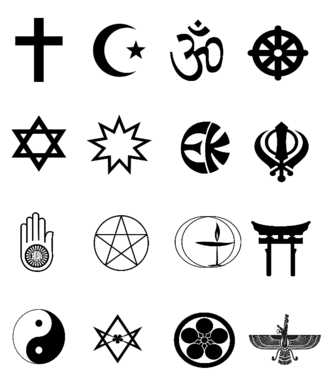
Religions can have sacred histories and stories which may be preserved in the sacred texts, symbols, and architecture. Religions attempt to explain the origin of life, the universe, and other phenomena. Traditionally, faith, in addition to reason, has been considered a source of religious beliefs.
There are thousands of distinct religions worldwide with more than 75% of the world’s population affiliated with Christianity, Islam, Hinduism, Buddhism.
Theology, once known as the “Queen of the Sciences” shaped people’s understanding of the natural world in the Middles Ages. As time went on and Enlightenment swept across Europe, many scientific findings clashed with the old ways of thinking, and soon after science and theology once knitted together became separate disciplines; sort of opposites of once close relatives. It widened over the years through scientific discoveries contradicting more and more with religious beliefs until Darwin’s theory of evolution which one and for all severed the relationship between science and religion, debunking the concept of a Designer. John Polkinhorne, Belief in God in an Age of Science
Taking place from the 14th century to the 17th century, the Renaissance promoted the rediscovery of classical philosophy, literature, and art and a cultural movement called humanism began to gain momentum in Italy as well.
Some of the most famous and groundbreaking Renaissance intellectuals, artists, scientists, and writers include the likes of da Vinci, Erasmus, Descartes, Galileo, Copernicus, Hobbes, not to mention the many explorers like Columbus, Vespucci, Polo among several others.
- In the 16th century, Martin Luther, a German monk, led the Protestant Reformation – a revolutionary movement that caused a split in the Catholic church. Luther questioned many of the practices of the church and whether they aligned with the teachings of the Bible. In 1545, the Council of Trent established the Roman Inquisition, which made humanism and any views that challenged the Catholic church an act of heresy punishable by death.
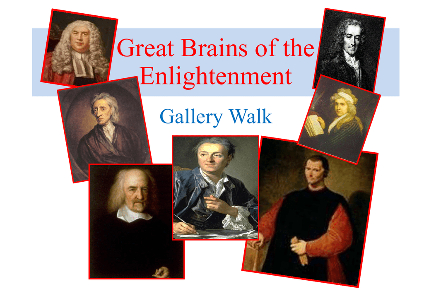
By the early 17th century, the Renaissance movement had died out, giving way to the Age of Enlightenment. The Enlightenment produced numerous books, essays, inventions, scientific discoveries, laws, wars, and revolutions. The American and French Revolutions were directly inspired by Enlightenment ideals and respectively marked the peak of its influence.
In addition to the theories, discoveries, and publications of those men mentioned above, the work of others like Newton, Locke, Voltaire, Jefferson, and many others changed the description of theistic God from one who was providential and interacting with the affairs of humans and the events on the planet to a deistic God who was like the proverbial “clockmaker” having set everything in motion and simply observed the free will actions of humans and the unfolding planetary events that resulted in earthquakes hurricanes, droughts, floods and much more. It was left up to the great achievements and discoveries that displayed the immense capabilities of the human species to control its behavior and cope with planetary events.
SPIRITUALITY
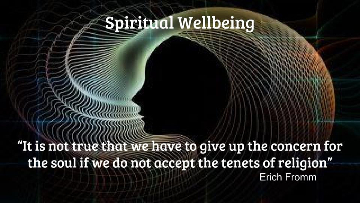
“The meaning of spirituality has changed over time with various connotations. In many cultures spirituality referred to a process of connecting humans to divinity. The term was used within early Christianity to refer to a life oriented toward the Holy Spirit and broadened during the Late Middle Ages to include mental aspects of life. In modern times, the term both spread to other religious traditions and broadened to refer to a wider range of experiences, including a range of religious traditions. Modern usages tend to refer to a subjective experience of a sacred dimension and the deepest values and meanings by which people live, often in a context separate from organized religious institutions. This may involve belief in a supernatural realm beyond the ordinarily observable world, personal growth, a quest for ultimate or sacred meaning, religious experience, or an encounter with one’s own inner dimension.”
The term spirit means “animating or vital principle in man and animals”. It is derived from the Old French espirit, which comes from the Latin word spiritus (soul, ghost, courage, vigor, breath) and is related to spirare (to breathe). In the Vulgate, the Latin version of the bible, the Latin word spiritus is used to translate the Greek pneuma and Hebrew ruach.
The term “spiritual”, matters “concerning the spirit”, is derived from Old French spirituel (12c.), which is derived from Latin spiritualis, which comes from spiritus or “spirit”.
The term “spirituality” is derived from Middle French spiritualité, from Late Latin “spiritualitatem” (nominative spiritualitas), which is also derived from Latin spiritualis.
There is no single, widely agreed-upon definition of spirituality.[2][3][note 1] Surveys of the definition of the term, as used in scholarly research, show a broad range of definitions with limited overlap.[1] A survey of reviews by McCarroll each dealing with the topic of spirituality gave twenty-seven explicit definitions, among which “there was little agreement.”[1] This impedes the systematic study of spirituality and the capacity to communicate findings meaningfully. Furthermore, many of spirituality’s core features are not unique to spirituality; for example self-transcendence, asceticism and the recognition of one’s connection to all were regarded by the atheist Arthur Schopenhauer as key to ethical life.[18][better source needed]
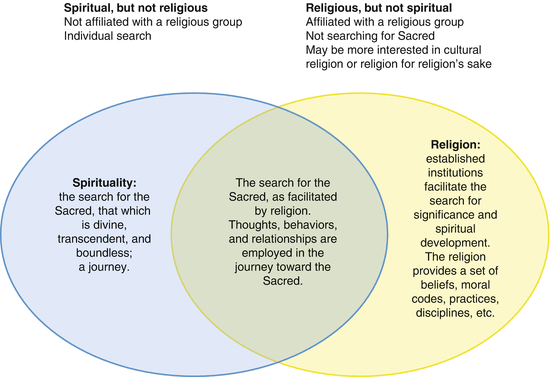
There is a key distinction which needs to be made between the religious and the spiritual. William James in his study of The Varieties of Religious Experience makes the distinction early in this lecture series that there exists “one great partition which divides the religious field. On the one side of it lies institutional, on the other personal religion” [19]. This personal religion is spirituality, what he defines as, “the feelings, acts, and experiences of individual men in their solitude, so far as they apprehend themselves to stand in relation to whatever they may consider the divine” [20]. Here as well, this notion of the divine is non-sectarian and non-institutional. The divine can be found, according to William James, in spiritual spaces without a Godhead, such as “Buddhism,” for instance, and he even claims that this notion of divinity is found in “Modern transcendental idealism” and in what he terms “[[3]]”, both of which “seem to let God evaporate into abstract Ideality. Not a deity in concreto, not a superhuman person, but the immanent divinity in things, the essentially spiritual structure of the universe […]” [21]. In this sense we can understand that the spiritual is not necessarily the religious, but rather, it is the experience & understanding of divinity (divinity in its broadest notion – deified or godless) which forms the elemental substrate of institutional religion as we know it today.
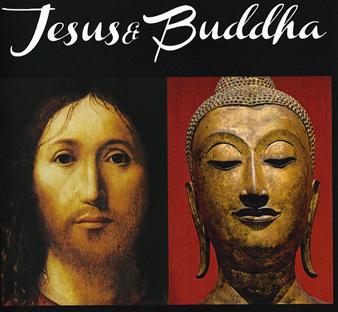
According to Kees Waaijman, the traditional meaning of spirituality is a process of re-formation which “aims to recover the original shape of man, the image of God. To accomplish this, the re-formation is oriented at a mold, which represents the original shape: in Judaism the Torah, in Christianity there is Christ, for Buddhism, Buddha, and in Islam, Muhammad.”[note 2] Houtman and Aupers suggest that modern spirituality is a blend of humanistic psychology, mystical and esoteric traditions, and Eastern religions.[14]
In modern times the emphasis is on subjective experience[9] and the “deepest values and meanings by which people live,”[10][11] incorporating personal growth or transformation, usually in a context separate from organized religious institutions.[12] Spirituality can be defined generally as an individual’s search for ultimate or sacred meaning and purpose in life.[15] Additionally it can mean to seek out or search for personal growth, religious experience, belief in a supernatural realm or afterlife, or to make sense of one’s own “inner dimension.”[13][14][16][17]
All of this being stated and described should lead one to comprehend the significant difference between religion and spirituality. The former arises out of tribal beliefs, rituals, art, architecture, music, and the culture or society within which the tribe exists. The latter, spirituality, is much broader and applies to many aspects of each individual: nature and nurture, personality and psychology, emotions and the biology and chemistry which interact with the person’s mind and body, and the uniqueness of each individual which some refer to the Self or the Soul.
Most of the above text is available under the Creative Commons Attribution-ShareAlike License; additional terms may apply. By using this site, you agree to the Terms of Use and Privacy Policy. Wikipedia® is a registered trademark of the Wikimedia Foundation, Inc., a non-profit organization.
For the Catholic teaching on this subject matter go to:
Catechism of the Catholic Church
 Faith Seeking Understanding